Contents

Australia’s emergence as an independent member of the world community depended on 2 developments which proceeded together:
- cutting legal ties with Great Britain, and
- developing independent Australian activity in international affairs.
In this chapter we outline these and link them to broader developments within Australia and the world throughout the 20th century.
Cutting of legal ties with Britain
There are 2 general points to keep in mind when tracing Australia’s legal independence from Great Britain. The first is that the rate of progress towards independence was not uniform at the Commonwealth and State levels. The Commonwealth’s relationship with the British authorities matured more quickly. As a result, the Commonwealth effectively achieved constitutional independence from the British authorities significantly earlier than the States.
The second point is that the strict constitutional position was often not an accurate reflection of the practical political situation. This means that the constitutional landmarks we will be discussing in this chapter did not, to any great extent, alter the way Australia was governed on a day-to-day basis or the practical relationship between Australia and Britain. Rather, these landmarks generally recognised and formalised a position which had existed for some time based largely on convention.
The Commonwealth and Britain
The young federation and World War I
The need for a single Australian voice in world affairs was a prime cause for federation and, accordingly, the Commonwealth Parliament was armed with the external affairs and defence powers – section 51(xxix) and section 51(vi). However, until 1914, the Commonwealth government was reasonably content with separate policies and representation only in commercial and technical matters, such as trade agreements and postal conventions, leaving the higher levels of diplomatic activity and matters of war and peace to a British government whose policy they sought to influence.
Prior to federation, as part of the British empire, the Australian colonies provided troops for the British forces in the Boer War, and from 1901 this was continued by the new Australian Commonwealth. When Britain declared war against Germany in August 1914, Australia, as a dominion of the British empire, was automatically also at war. From a total population of less than 5 million, more than 60,000 Australians were killed fighting in the war, 155,000 were wounded and 4,000 were taken prisoner. From 1914 to 1918 the Commonwealth exercised extensive powers in Australia in support of this war effort, regulating a wide range of activities under the defence power in section 51(vi).
Australia and the other British dominions obtained direct representation at the Versailles peace conference of 1919, becoming full members of the League of Nations, which was created as part of the peace settlement. As a result, they were at once involved in foreign affairs, defence negotiations and the play of international power politics at the highest levels. From 1902, British New Guinea (Papua) had been placed under the authority of the Commonwealth, and after World War I a mandate was issued to the Commonwealth for the government of German New Guinea, which it administered as a territory. Also after the war, a mandate was issued to the British Crown concerning the German Marshall Islands (Nauru), which was then administered by Great Britain, Australia and New Zealand, principally carried out by Australia.
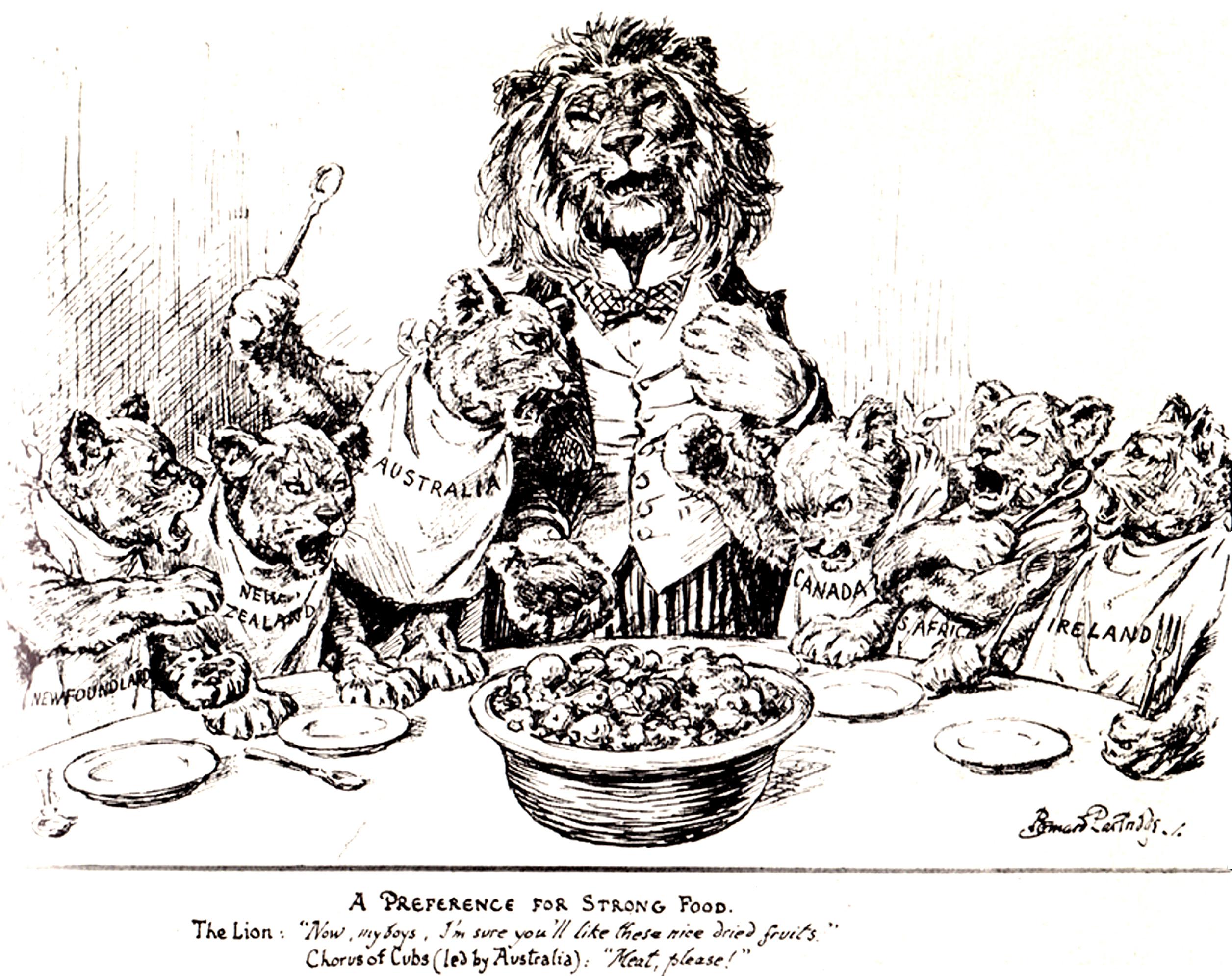
But generally, even after 1918, the Commonwealth government remained lukewarm about further recognition of the autonomy of the 'dominions', as the great former colonies had become, and the pace was set by Canada, South Africa and Eire (Ireland).
Imperial conferences and the Balfour Report
As a result of the wartime pressures, a series of imperial conferences was held between 1917 and 1930 to discuss the status of the dominions and their relationship with Britain. The conferences of 1917, 1926, 1929 and 1930 were especially important.
The 1926 imperial conference adopted a report drafted by a committee under the chairmanship of Lord Balfour. The key passage of the Balfour Report was as follows:
we refer to the group of self-governing communities composed of Great Britain and the Dominions. Their position and mutual relation may be readily defined. They are autonomous Communities within the British Empire, equal in status, in no way subordinate one to another in any aspect of their domestic or external affairs, though united by a common allegiance to the Crown, and freely associated as members of the British Commonwealth of Nations.
The report identified 5 matters in which there appeared to be conflict between the status of the dominions as autonomous self-governing communities and existing British legal powers or practices over the dominions:
- The royal style and titles. In 1927, legislation was passed to make it clear that the monarch was directly related to dominion governments and not indirectly through the British government.
- The position of Governors-General. A resolution of 1917 had already established that they were to be regarded solely as representatives of the monarch and not in any sense representatives of or answerable to the British government.
- Certain restrictions on the power of dominion parliaments to make laws. The most important restriction came from the Colonial Laws Validity Act 1865, which prevented laws passed by a dominion Parliament from being inconsistent with British legislation applying in the dominion (see [2.9]–[2.10]).
- The application of British merchant shipping legislation to the dominions.
- The Privy Council’s continuing status as the ultimate court of appeal for legal questions arising in the dominions.
The last 4 points were left for expert attention, but the report recorded as an accepted conventional rule, already applicable, that all surviving British legislative and executive powers directly bearing on dominion affairs were to be used only as requested by the relevant dominion government.
Statute of Westminster
The 1929 conference of experts on dominion legislation accordingly drafted a statute dealing with some of these matters. It was adopted by an imperial conference in 1930, circulated to the dominions for comment and with consequential revisions enacted by the British Parliament as the Statute of Westminster 1931. Sections 2 to 6, the most important sections of the Statute of Westminster, were not applicable to Australia until adopted by the Commonwealth Parliament. This adoption occurred in 1942 and was backdated to 3 September 1939 (the day Britain declared war on Germany). The adopting Act, with the Statute of Westminster as a schedule, is included as Statute of Westminster Adoption Act 1942. The following points about the Statute of Westminster should be noted.
First, the Statute of Westminster was concerned mainly with the application of British legislation in the dominions. It enabled the dominion parliaments (in Australia only the Commonwealth Parliament) to amend or repeal British legislation operating in a dominion. Previously, the Colonial Laws Validity Act restricted but continued in operation the common law rule giving supremacy to British statutes operating in Australia which were inconsistent with laws passed by the Commonwealth and State parliaments.
Section 2 of the Statute of Westminster took the Commonwealth Parliament out of the operation both of the common law rule and of the Colonial Laws Validity Act. (Section 5 and section 6 deal with certain imperial merchant shipping laws in case there was any doubt about their coming under section 2.) Therefore, after the Statute of Westminster, the Commonwealth Parliament, within its sphere of legislative power, could pass laws inconsistent with British legislation.
Secondly, this newly conferred power to amend or repeal British legislation meant that special provision had to be made to protect the Australian Constitution itself from direct amendment by the Commonwealth Parliament, given that, legally speaking, the Constitution was a law of the British Parliament. Australian anxieties, especially on the part of the States, were so great over this issue that this protection was conferred by section 8 and also by section 9(1) of the Statute of Westminster. The effect of these provisions is to ensure that the Australian Constitution cannot be amended by an ordinary Act of the Commonwealth Parliament (as opposed to the procedure involving a referendum of the Australian people set down in section 128 of the Constitution).
Thirdly, section 4 of the Statute of Westminster put in statutory form the convention that the British Parliament would not legislate for a dominion unless the latter so requested, and section 9(3) provided that in the case of Australia the request must come from both the Commonwealth Parliament and government. (Both these provisions were repealed by the Australia Act 1986, which is discussed at [3.28]–[3.47]).
Fourthly, section 3 declares that dominion parliaments have power to make their laws apply 'extraterritorially' – that is, to people, things and events which exist and occur outside the territory of the dominion. There was previously a doctrine of uncertain force which suggested that they could not pass such laws.
Constitutional conventions
Although the Statute of Westminster was greeted as the charter of dominion national independence, it was only a partial contribution to ending the various elements of British imperial supremacy. The conventions declared in 1917 and 1926 are equally important.
Reservation and disallowance
A matter covered only by these conventions relates to the reservation and disallowance of both Commonwealth and State legislation. All the Australian State constitutions gave their governors a discretionary power to reserve Bills passed by the State Parliament for the monarch’s personal assent and also empowered the monarch to disallow State Acts duly assented to by the governors within 1 or 2 years of their enactment. Similarly, in the Australian Constitution, section 58 gives the Governor-General a reservation discretion over laws passed by the Commonwealth Parliament, and section 59 gives the monarch the power to disallow within a year of enactment.
In the 19th century, such powers were occasionally exercised in relation to the colonies on the advice of the British Colonial Secretary, and more frequently an implied threat to use them was in the background of negotiations to modify colonial legislation. However, after 1880 no colonial Act was disallowed, and after 1900 no Bill was reserved under a discretionary power. No Commonwealth Act has been disallowed under section 59. Some State constitutions made reservation compulsory in the case of certain Bills, chiefly those amending the constitutions, but no Bill of this type was denied assent after 1900.
Section 74 of the Australian Constitution (in the last paragraph) requires reservation of Bills limiting appeals to the Privy Council; no Bill of this type has been denied assent. As we shall see, the Australia Act 1986 repealed the State provisions on reservation and disallowance, but not the Commonwealth ones. Despite this, the practice and the emphatic declaration of 1926 have long made the discretionary reservation and disallowance provisions irrelevant for practical purposes.
Position of Governors-General and the Privy Council
The position of the Governors-General is also still determined largely by convention. Canadian suggestions of a definition of their functions in relation to the dissolution and prorogation of Parliament (in Australia, section 5 of the Constitution) came to nothing. Until 1931, the Australian government was consulted about the choice of a Governor-General, but the final decision was made by the monarch on British advice. Then the Scullin government insisted on the appointment of an Australian, Sir Isaac Isaacs. After further appointments of titled Britishers, an Australian was again appointed on Australian advice in 1946, and by 1965 it had become settled practice for Australian governments, regardless of party, to procure the appointment of Australians, without any intervention by British ministers.
Appeals from Australian courts to the Privy Council were abolished in a number of steps described in chapter 8 (see [8.42]–[ 8.44], and also [3.36]–[3.37]).
World War II
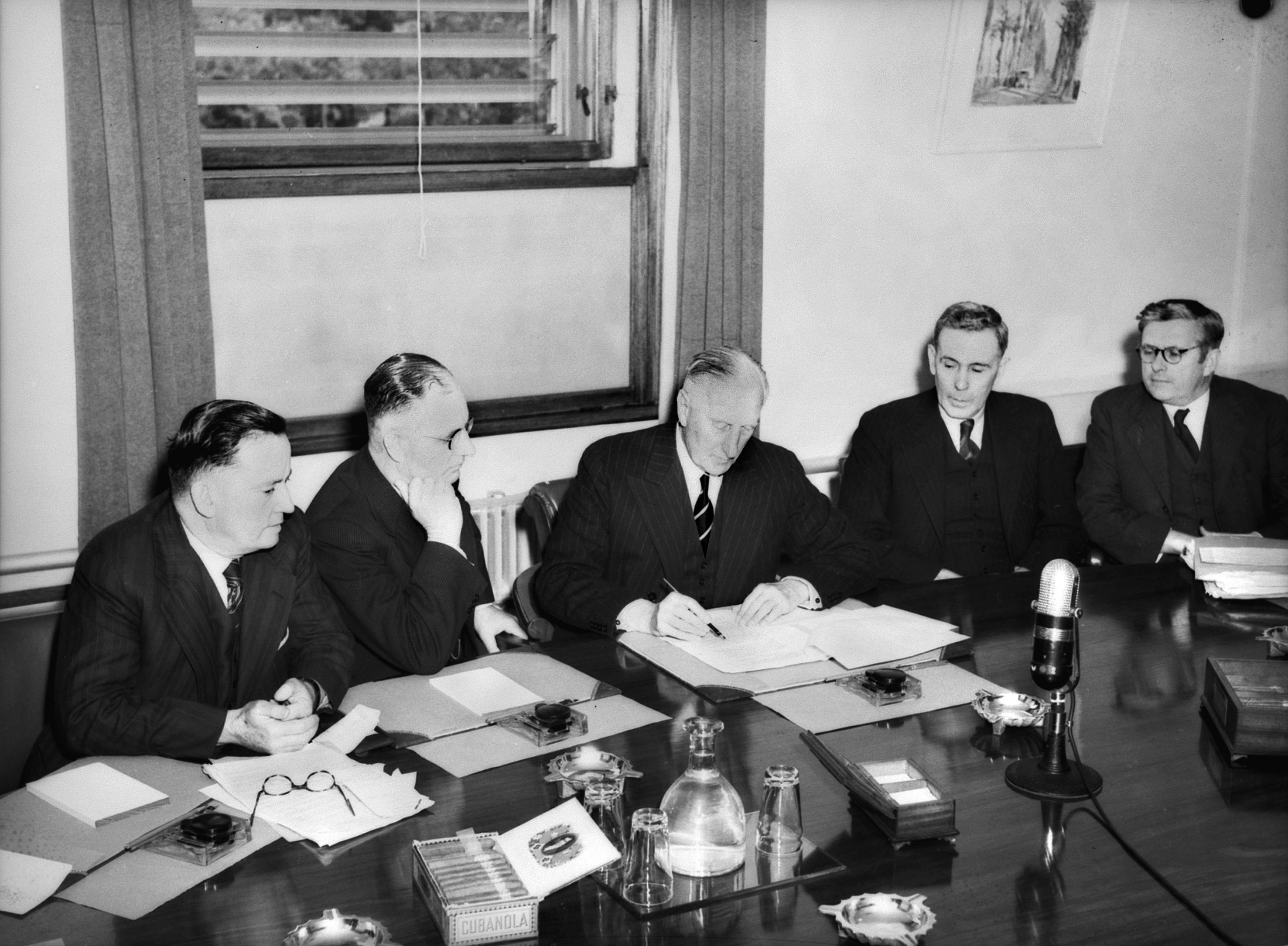
As we have noted, adoption of the Statute of Westminster occurred in 1942 and was backdated to 3 September 1939. On that date Prime Minister Menzies stated that Great Britain had declared war upon Germany and, as a result, Australia was also at war. Japan entered the war in December 1941 and in this case Australia itself made a separate declaration of war. Japan swiftly achieved a series of victories, and Australian troops returned from Europe to defend Australia. Of those Australian troops on active service in World War II, more than 35,000 were killed in action or died, 66,000 were wounded and 30,000 were taken prisoner of war, of whom more than 8,000 died in captivity. The Commonwealth again exercised extensive powers in Australia, regulating a wide range of activities under the defence power in section 51(vi). Australia played a significant role in the establishment of the United Nations following the war. After the war, the Territory of Papua and the Territory of New Guinea continued to be under Commonwealth control until Papua New Guinea was granted independence in 1975. Also after the war, Australia exercised full powers of legislation, administration and jurisdiction with respect to Nauru until it became independent in 1968 (see [3.6] in relation to the position before the war).
The Commonwealth and the Australia Act
The Statute of Westminster and the various conventions which developed to regulate relations with Britain largely severed, for practical purposes, the Commonwealth’s legal ties with the British authorities. However, as we shall see, it was not until the passage of the Australia Act that the British authorities formally abdicated all their powers over both the Commonwealth and the States.
The States and Britain
Before the Australia Act
It was implied in the scheme of federation adopted by Australia that the States would continue to have direct, independent relations with the British government on matters concerning their areas of activity. A proposal that they should deal with Britain through the Australian Governor-General was rejected, and a subsequent attempt by the British government to establish such a system failed. Thus, for example, the States alone procured the enactment by the British Parliament of the Australian States Constitution Act 1907, which restricted and made uniform the requirements for reservation and disallowance by the monarch of State legislation.
In the 19th century the States had begun the practice of appointing London representatives, called agents-general. After federation, the States saw their direct relations with Britain as an aspect of their power and prestige in relation to the Commonwealth authorities and, as such, necessary to maintain. The States failed to get separate representation at imperial conferences, but they secured assurances that matters within their exclusive competence would be discussed only incidentally and that in such cases they would be informed.
Having secured this position, the States then, generally speaking, declined to join with the Australian government and Parliament in the various steps towards the development of legal independence from Britain and an independent international personality for Australia. Hence, strictly speaking, the conventions and practices laid down at the imperial conferences of 1917, 1926, 1929 and 1930 did not apply to them. They sought and obtained exclusion from the operation of the Statute of Westminster and wanted even stronger guarantees against interference with their constitutional position than those contained in section 9.
Australia Act
However, from 1973 on, negotiations between the Commonwealth and State governments, and between them and the British government, resulted in the enactment of the Australia Act 1986. There are 2 Australia Acts – one Act passed by the Commonwealth Parliament at the request of each State Parliament and another Act in near identical terms passed by the British Parliament at the request and with the consent of the Commonwealth and the States. The reason 2 Acts were passed was to remove any legal doubt over the validity of what the Acts sought to do.
Australia Act as an Act of the Commonwealth Parliament
The introductory recital to the Australia Act passed by the Commonwealth Parliament claims that the Parliament has power to pass legislation under section 51(xxxviii) of the Constitution. Section 51(xxxviii) allows the Commonwealth, at the request or with the concurrence of the parliaments of the States, to exercise powers which, at the commencement of the Constitution in 1901, were only exercisable by the British Parliament. The official government view in 1986 was that section 51(xxxviii) allowed the Commonwealth Parliament, with the request of the State parliaments, to enact the Australia Act. Many academic and professional lawyers agreed with that official interpretation. However, some experts expressed contrary views and the position was not, in any event, entirely clear, given that the High Court had not, at that time, commented on the scope and operation of section 51(xxxviii).
Australia Act as an Act of the British Parliament
In order to overcome any possible doubt about the validity of the Australian enactment under section 51(xxxviii) it was agreed that, in addition to the Australian enactment, the British Parliament would separately enact an Australia Act in identical terms but with a different introduction reciting the request and consent to this British action by the Commonwealth and State parliaments. Request and consent was required because of section 4 of the Statute of Westminster and the convention governing British legislation applicable to the States. Subsequently, the High Court has taken the view that the Australia Act passed by the British Parliament was enacted out of abundant caution and that it is the Australia Act passed by the Australian Parliament which should be given force and effect according to its terms (Marquet (2003)).
Commencement of the Australia Act
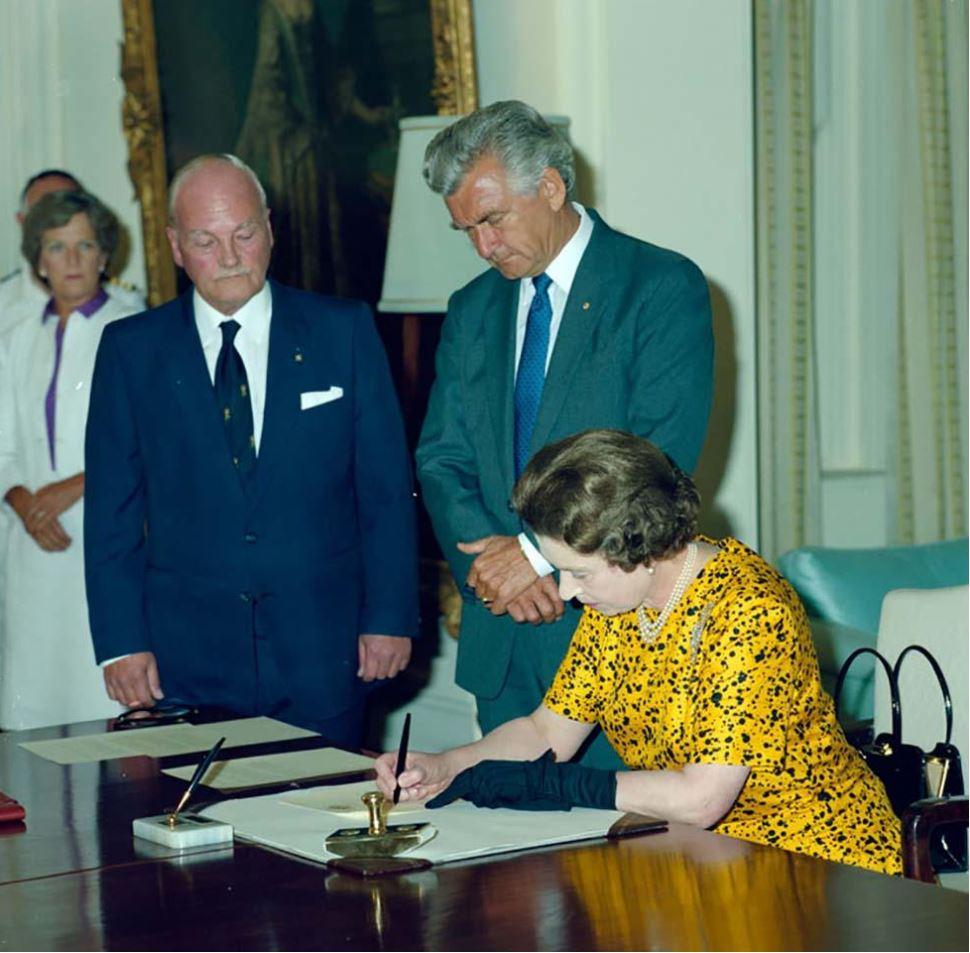
On 2 March 1986, the Queen, while in Canberra in the presence of the Australian Federal Executive Council, proclaimed the British and the Australian Acts into law as from 3 March 1986.
Content of the Australia Act
The Australia Act is longer and more complicated than the Statute of Westminster. It deals mainly with the position of the States, which, as noted above, was not covered by the Statute of Westminster and which had a long and complicated constitutional history going back far into the 19th century. It was possible to deal with this to some extent by general provisions applying to all States, but in addition special provisions were required for Queensland, Western Australia and New South Wales.
Although the Act assumes to a considerable degree that the Commonwealth had been sufficiently 'liberated' by the Statute of Westminster, it was nevertheless necessary to deal to some extent with the position of the Commonwealth and with possible repercussions of the Act’s provisions on relations between the States and the Commonwealth.
Abdication of British legislative power
The most general provision of the Australia Act, covering both the Commonwealth and the States and taking the Commonwealth further than the Statute of Westminster did, is section 1. This section provides for a complete abdication of Britain’s legislative power over, or as to, Australia at any level of its government. There is a legal theory that the British Parliament cannot bind its successors, so a future British Parliament could repeal this Act and, in particular, section 1. But, as the British judge Lord Sankey once said, that is 'mere theory', and we can safely assume that, in the unlikely event that a British Parliament did try to reverse the consequences of the Australia Act, no Australian parliament, government or court would take any notice of the attempt. The Australia Act, is, in that aspect, irrevocable, so far as Australia is concerned.
One consequence of this abdication of legislative power is that, after the commencement of the Australia Act in 1986, any amendment made by the British Parliament to British legislation that applied in Australia at that date does not apply to Australia. This was the case with the British legislation which in 2013 amended the rules of royal succession to provide that males would no longer necessarily rank higher in the line of royal succession than their female siblings. Instead, the older sibling would rank higher regardless of gender. (This amendment applied to royal births after 28 October 2011.) That amendment could not apply to Australia in relation to the Australian throne given section 1 of the Australia Act. To bring the rules of royal succession for the Australian monarch into line with those for the British monarch so as to ensure that the same person occupied both thrones, it was necessary for Australian legislation to mirror the British amendments. As with the enactment of the Australia Act itself, the Commonwealth Parliament relied on a request from each State parliament to invoke section 51(xxxviii) of the Constitution and enact the Succession to the Crown Act 2015.
Appeals to the Privy Council
One could be forgiven for thinking that section 11 of the Australia Act, dealing with appeals to the Privy Council, is also general and final, putting an end to all possibility of appeal to 'Her Majesty in Council' – the technical legal name of the Privy Council – from any Australian court. But when section 16 of the Act is considered, which defines various expressions, it will be seen that for the purposes of the Australia Act the words 'Australian court' exclude the High Court of Australia.
Section 11 does put an end to all possibility of appeals from any Australian court other than from the High Court to the Privy Council in the special circumstances set out in section 74 of the Constitution. Moreover, as discussed in chapter 8 (see [8.42]–[8.44]), there is now no practical possibility that the Privy Council will be allowed to hear an appeal from the High Court under section 74 of the Constitution. To all intents and purposes, section 11 of the Australia Act removed the Privy Council from Australia’s legal system.
Autonomy of the States
In many respects, the Australia Act does for the States what the Statute of Westminster did for the Commonwealth. In doing so it addresses what Sir Owen Dixon described as the 'illogical course' taken by the Statute of Westminster under which the Commonwealth could operate free from the overpowering force of British legislation, but the States could not. Sections 2, 3, 4, 8, 9, 13 and 14 abolish various specific ways in which old British Acts and provisions in the State constitutions might, if left in effect, abridge the autonomy of the States or authorise British interference in their affairs. In particular, section 2 removes any doubts which may have existed over the capacity of the States to make laws with extraterritorial effect, while section 3 removes State legislation from the operation of the Colonial Laws Validity Act. Therefore, the States may now pass laws which are inconsistent with British legislation subject to the exception that a State parliament cannot pass a law inconsistent with either the Statute of Westminster or the Australian Constitution (see section 5 of the Australia Act).
Reservation and disallowance of State legislation
A particularly interesting aspect of the Australia Act, in view of the continuing Commonwealth position, is the abolition by section 8 and section 9 of all State or British laws which require State governors to disallow Bills duly passed by parliament or empower them to reserve Bills for reference to the Queen, or which empower the Queen to disallow any Act. Section 10, one of the few ringing and rhetorical provisions in this eminently lawyer-like document, absolves the British government from any responsibility for the government of any Australian State.
None of these provisions apply to the Commonwealth. This means that, for example, the provisions for reservation and disallowance of Commonwealth Bills or Acts in sections 58, 59 and 60 of the Australian Constitution remain in effect. The upshot is, ironically, that the previously more closely tied States are now in some respects more completely severed from Britain, at least in theory, than is the Commonwealth.
Governors
Still dealing only with the States, section 7 recognises the office of State governors, representing the Queen, but removes any royal powers to direct them in their activities. All royal powers are to be exercised by the governors, except the appointment and removal of governors themselves, other than when the Queen is personally present in a State. However, the Act still leaves wholly to convention, not law, the principles governing the exercise by the monarch and the governors of their powers.
Repeal of the Statute of Westminster provisions by the Australia Act
Section 12 of the Australia Act repeals 4 provisions of the Statute of Westminster: sections 4, 9(2) and 9(3) and 10. Sections 4, 9(2) and 9(3) are repealed because they assume continuing power in the British Parliament to legislate for Australia. Section 10 is repealed so far as to remove the possibility of the Commonwealth opting out of the Statute of Westminster. This ensures that the Statute of Westminster remains a basic part of the constitutional structure and is capable of amendment or repeal only as provided in section 15 of the Australia Act.
Maintenance of existing federal structure
The Australia Act, which brought about the complete independence and sovereign nation status of Australia, inevitably had some impact as well on the domestic constitutional law of the nation, and this comes out particularly in sections 5, 6 and 15. These provisions are designed to ensure that the existing federal structure of Australia, and the constitutional laws in force in its member units – the Commonwealth and federal territories, and the 6 States – remain in force and can be amended only by the methods provided in those instruments.
Thus section 5 recognises and confirms that the Australian Constitution can be amended only by the Commonwealth Parliament acting with the consent of the people expressed in a referendum, as provided by section 128 of the Constitution. Similarly, section 6 ensures that State constitutional provisions requiring special legislative majorities or approval at referendums are kept in force.
Amendment of the Australia Act and the Statute of Westminster
Section 15 requires special attention. Its general purpose is to provide ways of amending, by procedures available in Australia, what have now become basic constitutional documents of the Australian nation – remembering that the British Parliament, which used to be Australia’s ultimate resource if no available Australian procedure could deal with some matter, has now abdicated this function. The first subsection of section 15 is clear: the Statute of Westminster and the Australia Act can be amended or repealed by a Commonwealth statute to which the parliaments of all the States agree. This subsection also makes clear that the Commonwealth cannot rely on any other head of legislative power which it possessed under the Constitution as it stood at the commencement of the Australia Act to enact a law amending or repealing those Acts. If the matter rested there, the result would be a relatively rigid constitutional structure, since getting all the States to agree on an amendment can be a difficult task.
So the third subsection of section 15 mitigates the threatened rigidity by specifying another method of amending or repealing the provisions of the Statute of Westminster or the Australia Act. This is by conferring power to do whatever needs doing at a particular time on the Commonwealth Parliament by amendment of the Australian Constitution (which may be done under section 128 of the Constitution). As discussed in chapter 11, amendment of the Constitution requires a cumbersome process – a referendum carried by a majority of electors and majorities in a majority of States, approving an amending Act of the Commonwealth Parliament. Indeed, for some Acts (for example, one abolishing the States in order to create a centralised, non-federal system), majorities would be needed in all the States. Nevertheless, it is possibly less difficult in some circumstances than getting the agreement of all the State parliaments.
The first and third subsections of section 15 are not intended to limit the form of amendments that may be made to the Constitution so as to repeal or amend the Australia Act or the Statute of Westminster. There would be a serious question whether the Australian version of the Australia Act could validly impose such a limitation. Rather, the third subsection ensures that, despite the limitations imposed by the first subsection on how an Act of the Commonwealth Parliament may repeal or amend those Acts, an Act of the Commonwealth Parliament may do those things if an amendment to the Constitution confers on the Commonwealth Parliament the power to enact such a law – for example, an amendment to section 51 of the Constitution inserting a head of power with respect to 'amending or repealing the Australia Act'.
Fully sovereign self-governing nation
The result of these provisions is to leave Australia a fully sovereign, self-governing nation with a rather rigid basic constitutional structure, but one capable of a great deal of adjustment in detail by its component parts. The basic structure is in the 3 great constitutional documents:
- the Commonwealth of Australia Constitution Act 1900
- the Statute of Westminster 1931, and
- the Australia Act 1986.
The conduct of external affairs
As we have noted, the British dominions obtained direct representation at the Versailles peace conference of 1919, becoming full members of the League of Nations. As a result, they were at once involved in foreign affairs, defence negotiations and the play of international power politics at the highest levels. In 1920, the British government agreed to a procedure by which dominions could appoint Ministers Plenipotentiary (diplomatic representatives with full powers) to foreign countries by royal instrument, made solely on the advice of the dominion government concerned. The minister would answer solely to that government.
The extent to which dominions took advantage of these opportunities varied. Australia was slow to do so and was content until 1942 to operate mainly through the British Foreign Office, apart from League of Nations activities. In 1939, the Menzies government took the view that Australia was automatically at war because Britain had declared war on Germany. However, in 1940 the Commonwealth government appointed a Minister to Japan. In 1941, the Curtin government made a separate declaration of war against Japan and, from 1942 on, a separate Australian foreign service was created.
Australian delegations played an active independent role in the formation of the United Nations (1944–1945) and subsequently in United Nations affairs, and the practice of negotiating or entering into treaties, conventions and other international agreements together with Britain ceased. Australia is now a party to a complex network of international agreements, negotiated by its own representatives, made in its name and ratified by the Commonwealth government.
Making international agreements
The conduct of foreign affairs – and, in particular, the making and ratifying of international agreements – is by Australian law the function of the Commonwealth government. The Commonwealth government’s power in relation to international agreements is part of the general executive power conferred by section 61 of the Australian Constitution, as is the power to appoint persons (such as ambassadors) to represent Australia overseas (see also section 67 of the Constitution). Until 1973 it had remained the practice for the Queen to execute, on Australian advice, the formal documents connected with diplomatic representation of Australia; since then, the practice has been that all such documents are executed by the Australian Governor-General.
Effect of international agreements
An international agreement entered into by Australia is binding under international law. The general principles of international law are also binding. These obligations can be subject to relevant international law enforcement mechanisms, such as in proceedings by another nation state against Australia in the International Court of Justice. For example, in 1989 Nauru took proceedings against Australia in respect of a dispute over the rehabilitation of certain phosphate lands mined under Australian administration before Nauruan independence (see [3.23]). In turn Australia can also bring these proceedings – for example, in 2010 Australia brought a case against Japan in relation to its whaling program. But, generally speaking, an international agreement does not become part of Australian law unless the Commonwealth Parliament passes an Act giving that agreement the force of law. For example, the Commonwealth government has signed the International Convention on the Elimination of All Forms of Racial Discrimination. People in Australia who feel that their employer has discriminated against them on the ground of race could not rely on the Convention itself when bringing an action in an Australian court. Those people only have enforceable rights because the Commonwealth Parliament has enacted a law giving effect to the Convention: the Racial Discrimination Act 1975. However, the treaties themselves can have some legal effect in Australian law – for example, as discussed at [9.64], Commonwealth legislation is generally interpreted, so far as its language permits, consistently with relevant treaties, at least where the law is enacted after or in contemplation of the treaty.
In addition, there are optional protocols to several human rights treaties which allow international bodies to consider complaints brought by an individual against a nation state where the individual has exhausted their domestic remedies. For instance, Australia is a party to the first optional protocol to the International Covenant on Civil and Political Rights, which provides for this type of individual complaints mechanism. The Commonwealth has also agreed to the individual complaints mechanisms under the human rights treaties dealing with racial discrimination, discrimination against women, torture and disability discrimination. In response to a complaint the international body can only make recommendations which are not legally binding, although these often lead to significant political pressure for a change to any law or action found to be in breach of international human rights. Strictly, however, as a matter of Australian constitutional law, it is open to Parliament to make a law even if it is directly inconsistent with the terms of a treaty to which Australia is a party.
Until 1973 the tendency had been to leave it to the State parliaments to pass laws required by international agreement if the topic was ordinarily within State power. Since then the Commonwealth has primarily acted itself to implement international agreements by relying on its power over 'external affairs' (section 51(xxix) of the Constitution). The Commonwealth’s implementation of international agreements in relation to matters which traditionally fell within State responsibility has led to suggestions that the external affairs power has the potential to upset fundamentally the balance of power between the States and the Commonwealth. The scope of the external affairs power and its implications for the 'federal balance' are discussed in chapter 5 – in particular, at [5.23]–[5.34].
Citizenship
Allied to Australia’s evolution into a sovereign independent nation was the development of a distinct Australian citizenship. The Constitution does not contain any reference to Australian citizenship. Indeed, at the advent of federation in 1901, and for a long time after that, there was no such concept. All persons in Australia were either British subjects or aliens. The absence of an Australian citizenship was highlighted by a 1907 High Court case in which Mr Ah Sheung argued that, by living in Australia for many years, he had acquired 'Australian nationality' and, as such, he was not an immigrant within the reach of the Commonwealth Parliament’s immigration power (section 51(xxvii)). The High Court, led by Chief Justice Griffith, summarily dismissed this argument in Ah Sheung (1906), saying:
We are not disposed to give any countenance to the novel doctrine that there is an Australian nationality as distinguished from a British nationality, so that, while the term 'immigration' as used in section 51 of the Constitution admittedly includes the power of exclusion of British subjects in general, it would not extend to persons of Australian nationality, whatever that may mean.
Australian citizenship
It was not until almost 50 years after federation that the Commonwealth Parliament created the status of Australian citizenship. As one commentator has observed, until then 'Australia, both as a people and as a nation, appeared indifferent to the need to assert a separate formal nationality'.
The Commonwealth Parliament eventually enacted the Nationality and Citizenship Act 1948 (now the Australian Citizenship Act 2007), which came into force on 26 January 1949. This Act established for the first time the principle of Australian citizenship. The Commonwealth Parliament’s authority to define and regulate Australian citizenship comes mainly from its express power over 'naturalization and aliens' in section 51(xix) of the Constitution.
Who can be treated as an 'alien'?

The question of who can and cannot be treated as an alien under laws passed by the Commonwealth Parliament has been the subject of a significant number of High Court cases. Many of these cases have concerned British subjects who immigrated to Australia after the commencement of the Nationality and Citizenship Act in 1949 but who did not take out citizenship under that Act. The challenge in resolving these cases was attributable to 2 features of Australia’s constitutional development to which attention has already been drawn: first, the difficulty of confidently identifying a precise date when Australia became independent from Britain; and, secondly, the related difficulty of identifying when the sovereign to whom Australians owed allegiance transformed from the British sovereign into the Australian sovereign. As a result, it was not clear to what extent British subjects resident in Australia could be treated as aliens by the Commonwealth Parliament on the basis that they were the subjects of a foreign sovereign.
After a series of cases which exposed divisions within the High Court on this issue, the question was settled by Shaw (2003). In that case, the High Court held, by a majority of 4 to 3, that such British citizens could be treated as aliens for the purposes of section 51(xix) of the Constitution regardless of when, after 1949, they had immigrated to Australia.
The High Court’s decision in Singh (2004) indicates that the Commonwealth Parliament has a relatively broad, but not unconstrained, power to determine which classes of persons it may treat as aliens. Specifically, a majority of the Court held that a child who was born in Australia, and had remained in Australia for 6 years from birth, was not by virtue of those facts alone outside the reach of the aliens power. Through her parents she was a citizen of India under Indian law, and a majority of the Court held that that allegiance to another country allowed her to be treated as an alien.
The case of Love and Thoms (2020) raised the question of whether a person who was generally regarded as an Australian Aboriginal or Torres Strait Islander could nevertheless be treated as an alien within the meaning of the aliens power if they had been born overseas, had acquired the citizenship of another country and had not taken out Australian citizenship. By a majority of 4 to 3, the High Court held that the Parliament could not treat such a person as an alien. That is, regardless of their birth overseas and their foreign citizenship, if a person was of Aboriginal descent (for example, they had grandparents who were Aboriginal people), they identified as an Aboriginal person and they were a member of a society of Aboriginal people who acknowledged and observed traditional laws and customs, they could not be an alien. Therefore, Parliament could not provide for the removal from Australia of those people where they had committed a serious crime. The decision is interesting because it recognises a class of persons who are neither Australian citizens nor aliens. Previously the Commonwealth had largely legislated and acted on the basis that a person was either a citizen or an alien. It is also interesting because of the sharp division of opinion between the justices of the Court over the extent to which the evolving common law recognition of Aboriginal peoples’ status and rights (as indicated in the Mabo (No 2) (1992) decision (see [10.20]–[10.26])) is relevant to the interpretation of the Constitution (see [8.71]).
How can Australian citizenship be obtained and lost?
Under the Australian Citizenship Act as currently in force, the main grounds on which citizenship may be obtained are:
- by birth – since 20 August 1986, a person born in Australia is automatically an Australian citizen if at least one parent was either an Australian citizen or an Australian permanent resident at the time of the person’s birth, or
- by being granted citizenship – generally, people can apply to be granted citizenship if they have been in Australia for 4 years immediately before they apply. An applicant for citizenship needs to satisfy a number of conditions, including being a permanent resident in the 12 months before they apply, being at least 18 years of age, being of good character and passing a citizenship test.
Before people are granted citizenship they are required to make a Pledge of Commitment. The Pledge, which in January 1994 replaced the old Oath of Allegiance, is as follows:
From this time forward, under God,
I pledge my loyalty to Australia and its people,
whose democratic beliefs I share,
whose rights and liberties I respect,
and whose laws I will uphold and obey.
The words 'under God', are optional, depending on the beliefs of the person making the oath.
It is possible for a person to lose their Australian citizenship in certain circumstances. Under the Australian Citizenship Act a person may ask to give up their Australian citizenship or may lose their Australian citizenship as a result of their conduct. For example, a person who is aged over 14 years, and is a national or citizen of another country, will cease to be an Australian citizen if they engage in particularly serious conduct which is inconsistent with their allegiance to Australia. This includes engaging in a terrorist act as a member of a terrorist organisation. The possible range of people who can be stripped by Commonwealth legislation of their Australian citizenship will to a large extent depend on the breadth of the constitutional concept of aliens in section 51(xix).
But who can decide a person is stripped of citizenship also raises constitutional issues. The High Court case of Alexander (2022) concerned a law which provided that a Minister could decide that a person ceases to be a citizen on the basis of their conduct, but without any criminal conviction. A majority of the High Court held that such a decision could not be given to a Minister, since it imposed a punishment which was an exercise of judicial power, and could only be made by a court after a judicial process (see [8.32] and [9.46]–[9.47]).

