Contents
- The functions of executive government
- Crown, King and Governor-General
- Prime Minister, ministers and Cabinet
- Relationship between the executive and the Parliament
- Relationship between the executive and the courts
- Departments and other agencies
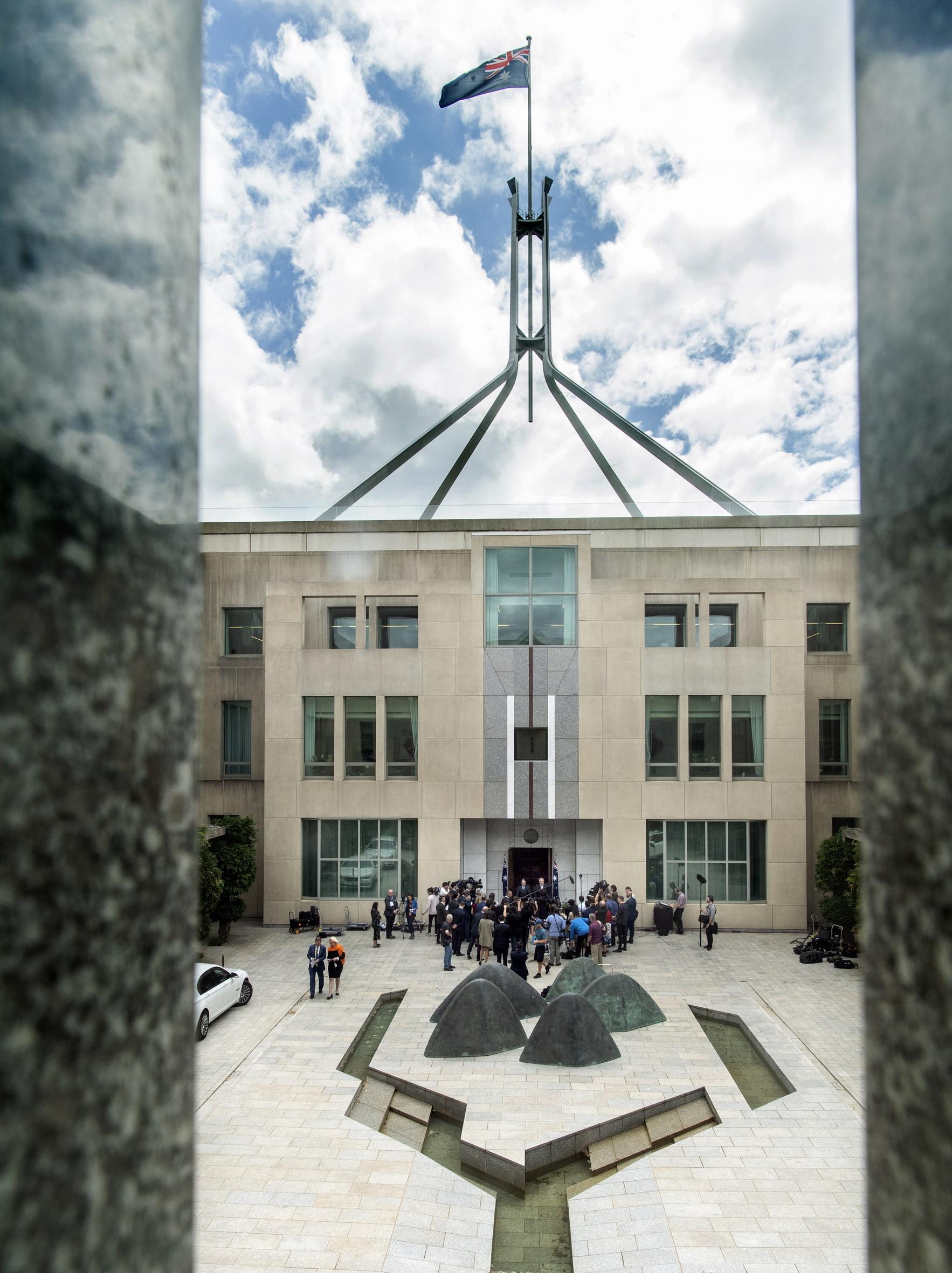

Chapter II of the Constitution deals with the executive government of the Commonwealth. The Parliament is a relatively small, clearly defined part of a constitutional system, and so are the courts of law. The executive government, however, has become – in Australia at any rate – a vast, sprawling collection of institutions and people that exercise a wide range of functions which impact extensively on the lives of Australians.
Two important preliminary points can be made about the executive government. First, as we discuss, the Constitution gives an inadequate and, in some respects, misleading impression of what comprises the executive government and how it operates. Some provisions about the executive need to be read and understood in the context of the broader structure and fundamental principles of the Constitution.
Secondly, the activities of the executive government sometimes even include functions that have the characteristics of the legislative task of making new laws and even some of the characteristics of the judicial task of deciding individual cases in the light of some pre-existing standard. This mixing of functions is most apparent at the State level, as there is generally no constitutional doctrine to obstruct the States from using executive officials to perform legislative or judicial functions. By contrast, at the federal level there is a constitutionally entrenched doctrine of the separation of powers – in particular, a separation between the courts on the one hand and the executive government on the other.
The functions of executive government
Executive power of the Commonwealth
Section 61 of the Constitution says that the executive power of the Commonwealth is vested in the Queen and is exercisable by the Governor-General. Section 61 does not set out the content of Commonwealth executive power beyond noting that it extends to the execution and maintenance of the Constitution and of the laws of the Commonwealth. An older, 19th century conception of executive power covered 2 main functions:
- the formulation of policy advice and proposals for legislation to be considered and possibly enacted by Parliament, and
- the taking of steps to have laws observed or carried out, so far as this required government action – typically, in the 19th century laissez faire state, by prosecuting and punishing citizens who failed to comply with these laws.
Policy formulation and law enforcement activities remain an important aspect of executive government, but the 'execution of ... laws' referred to in section 61 of the Constitution has come to mean mainly the carrying out of active social policies by government. The Parliament often implements these social policies by laying down general principles and standards in an Act of Parliament and then delegating to the executive government the task of filling out the details.
This often includes the making of 'delegated' legislation by the executive (ordinarily the Governor-General in Council), commonly called 'regulations', 'rules' or 'orders'. The volume of these in any year is often 4 times or more the volume of parliamentary Acts.
Some details also include the making of administrative decisions in individual cases as to whether a particular action will be taken, such as determining whether a pension or health benefit should be paid or whether a tax refund is due.
Sources of executive power
The executive power, conferred by section 61 of the Constitution and exercised by Commonwealth officials, falls broadly into 3 categories:
- Executive power may be conferred by the Constitution or by statutes made by the Parliament. For example, the Income Tax Assessment Act 1936 confers a variety of powers on Commonwealth officers to assess and collect income tax. This is often referred to as statutory executive power.
- The Commonwealth government may carry out various tasks even where no legislation authorises those tasks. This is often referred to as non-statutory executive power. However, the Commonwealth government cannot usually require people to do things in the absence of legislative authority. Further, its capacity to carry out even non-coercive functions has been reduced by a number of High Court decisions which rejected the view that the Commonwealth government had traditionally acted on – that it was a body politic with legal personality which allowed it to act in the same way as any other legal person generally, or at least to the extent that it was acting in areas over which the Australian Parliament had legislative power. On this view, under its non-statutory executive power the Commonwealth could establish and administer, without legislation other than an appropriation, a program providing financial assistance to persons engaging in interstate and overseas trade and commerce because that was a matter over which the Parliament had legislative power under section 51(i) of the Constitution. As discussed at [5.62]–[5.63], however, the High Court has held that Commonwealth funding agreements for the provision of financial assistance and services require supporting legislation, even though generally a legal person can enter into such contracts and expend money under them.
- The Commonwealth government, like the State governments, has another form of non-statutory executive power generally known as prerogatives – special powers, privileges and immunities which historically were vested in the monarch. The Crown traditionally possessed a large number of prerogatives, but their practical importance in more recent years has been diminished by different pieces of legislation which have abolished or given a statutory basis to many of them. Nevertheless, the Commonwealth government continues to possess and to exercise important prerogative powers under section 61 of the Constitution, particularly in relation to the conduct of foreign affairs. For instance, the declaration of war and peace and the signing of treaties remain important prerogative powers. The division of prerogatives between the Commonwealth and the States generally follows the Constitution’s allocation of legislative power. The prerogatives in relation to war and peace and treaties are exercisable by the Commonwealth because of its legislative responsibility for defence (section 51(vi) and section 114) and external affairs (section 51(xxix)).
Limitations on executive power
The executive power of the Commonwealth is subject to some important restrictions. A fundamental restriction already referred to at [7.8] is that a government official cannot exercise coercive powers against an individual unless that conduct is authorised by legislation or the common law. Coercive powers include entering and searching a person’s property without their consent or requiring a person to pay a tax.
Similarly, an executive officer cannot ordinarily do anything which is generally prohibited by legislation. It follows that a police officer cannot legally import heroin into Australia without statutory authority even if the importation is part of a scheme to catch known or suspected drug dealers. Rather, legislation is needed to take such actions by police officers outside the drug offence.
There are lawful, non-coercive actions which government officials can take without the need for legislation authorising the conduct although, as indicated at [7.8], the range of these actions has significantly contracted following the High Court’s decisions in the Williams cases discussed at [5.62]–[5.63].
Crown, King and Governor-General
The concept of the Crown
It is not unusual to hear references to such things as 'Crown property', 'prerogatives of the Crown' and 'ministers of the Crown'. The 'Crown', when used in this context, is a legal entity. It symbolises the central executive element in Australia’s various bodies politic. It owns property, makes contracts, employs officials and takes and defends actions in the courts.
In the Australian federal system, the Crown has to be taken as a separate entity for each body politic – the Commonwealth and all the States. We see this demonstrated in the many legal proceedings in the High Court between the Commonwealth and one or more States. It is also appropriate, following the conferral of a large measure of self-government on the Northern Territory and the Australian Capital Territory, to speak of the 'Crown in right of the Northern Territory' and the 'Crown in right of the Australian Capital Territory'.
In this context, despite what the terms of the Constitution might suggest (see [7.15]), neither the King nor his direct representative, the Governor-General, has much political power. They do not actually employ or direct anyone but their personal staff. For the most part, except in limited extraordinary circumstances (see [7.17]–[7.26]), they carry out formal or ritual acts which embody decisions taken by someone else – ordinarily a minister of the Crown or the Cabinet. Therefore, as the High Court has noted, the concept of the Commonwealth Crown is better understood as simply the Commonwealth executive government.
Executive powers of the King and the Governor-General
As noted, a literal reading of Chapter II of the Constitution suggests that the King and the Governor-General have sweeping executive powers which they may exercise at their personal discretion. For example, section 68 says that the Governor-General is the commander-in-chief of the naval and military forces of the Commonwealth.
In reality, the King exercises very few powers and those which he does, such as appointing the Governor-General, are done in accordance with advice from the Prime Minister. The Governor-General performs a large number of functions. However, in all but exceptional cases, the principles of responsible government require that the Governor-General act in accordance with ministerial advice.
Reserve powers
The small number of powers which the Governor-General may exercise in certain circumstances without – or contrary to – ministerial advice are known as the 'reserve powers'. Only 4 powers are commonly regarded as reserve powers. These are:
- the power to appoint the Prime Minister (section 64)
- the power to dismiss the Prime Minister, and therefore the government (section 64)
- the power to refuse to dissolve the House of Representatives (section 5), and
- possibly, the power to refuse a dissolution of both houses (section 57).
In most cases the exercise of the reserve powers is governed by a 'convention' – that is, a rule of conduct which, although not legally enforceable, is generally accepted and acted upon by all parties. For example, when appointing the Prime Minister, there is the universally acknowledged convention that the Governor-General should appoint the parliamentary leader of the party or coalition of parties which has a majority of seats in the House of Representatives, or at least the support of the majority.
The dismissal of the Whitlam government
However, situations can arise where there is no generally agreed convention to resolve a dispute. Such was the position in 1975 when the Senate, which was not controlled by the government, blocked the passage of the Supply Bill in an attempt to deprive the Labor government of the funds necessary to carry on government.
As a result of the Senate’s actions, on 11 November 1975 the Governor-General, John Kerr, dismissed the Prime Minister, Gough Whitlam, and appointed in his place the leader of the opposition, Malcolm Fraser. Fraser, as the new Prime Minister, immediately advised the Governor-General to dissolve both houses of Parliament under section 57 of the Constitution. (Several Bills which had twice been rejected by the Senate provided the trigger for the double dissolution.)
The Governor-General’s dismissal of Whitlam was probably the most controversial act in Australia’s constitutional history. Some commentators argue that Kerr acted properly in terminating Whitlam’s commission as Prime Minister because it was consistent with the convention that a Prime Minister who cannot obtain supply should either advise the Governor-General to dissolve the House of Representatives (and call an election) or be dismissed.
Other commentators dispute that there was or is any such convention. They maintain that the dismissal of Whitlam breached the fundamental convention that a person who retains majority support in the House of Representatives, as Whitlam did, is entitled to remain Prime Minister (at least in the absence of any serious and persistent illegality).
Finally, there are those who maintain that the Governor-General was in an impossible position and that the constitutional crisis of 1975 had more to do with the respective powers of the Senate and the House of Representatives than with the reserve powers of the Governor-General.

Dissolution of the Parliament
As a matter of convention, the power of the Governor-General to dissolve the House of Representatives under section 5, and both houses under section 57, is exercised in the vast majority of cases solely as advised by the Prime Minister. Again, however, situations can arise where the proper course for the Governor-General to take in exercising these reserve powers is not entirely clear. For example, a Prime Minister may advise the Governor-General to dissolve the House of Representatives where there is at least some possibility that another member could obtain majority support in that House. (This situation can occur if the Prime Minister requesting a dissolution has lost majority support because he or she depended on independents who have switched support, or on a coalition arrangement which has broken down, or because of a split in their own party.)
Assuming there is no alternative person who clearly commands majority support in the House, but there is at least some possibility that a new government could be formed from the floor of the House, what should the Governor-General do – agree to the dissolution, wait and see, or take a more active role in determining whether anyone is capable of forming a government?
In such circumstances, there may be a case for advising a fresh appeal to the people if the next House election is (in any event) required within a relatively short time. The difficulty arises, however, where the political crisis occurs early in the life of the Parliament. The Governor-General can reasonably expect the members of Parliament to make an effort to achieve a workable ministry and save the people the expense of a fresh poll within the first year after a general election, but how they would act after 12 months and before 2 years is less predictable.
Prime Minister, ministers and Cabinet
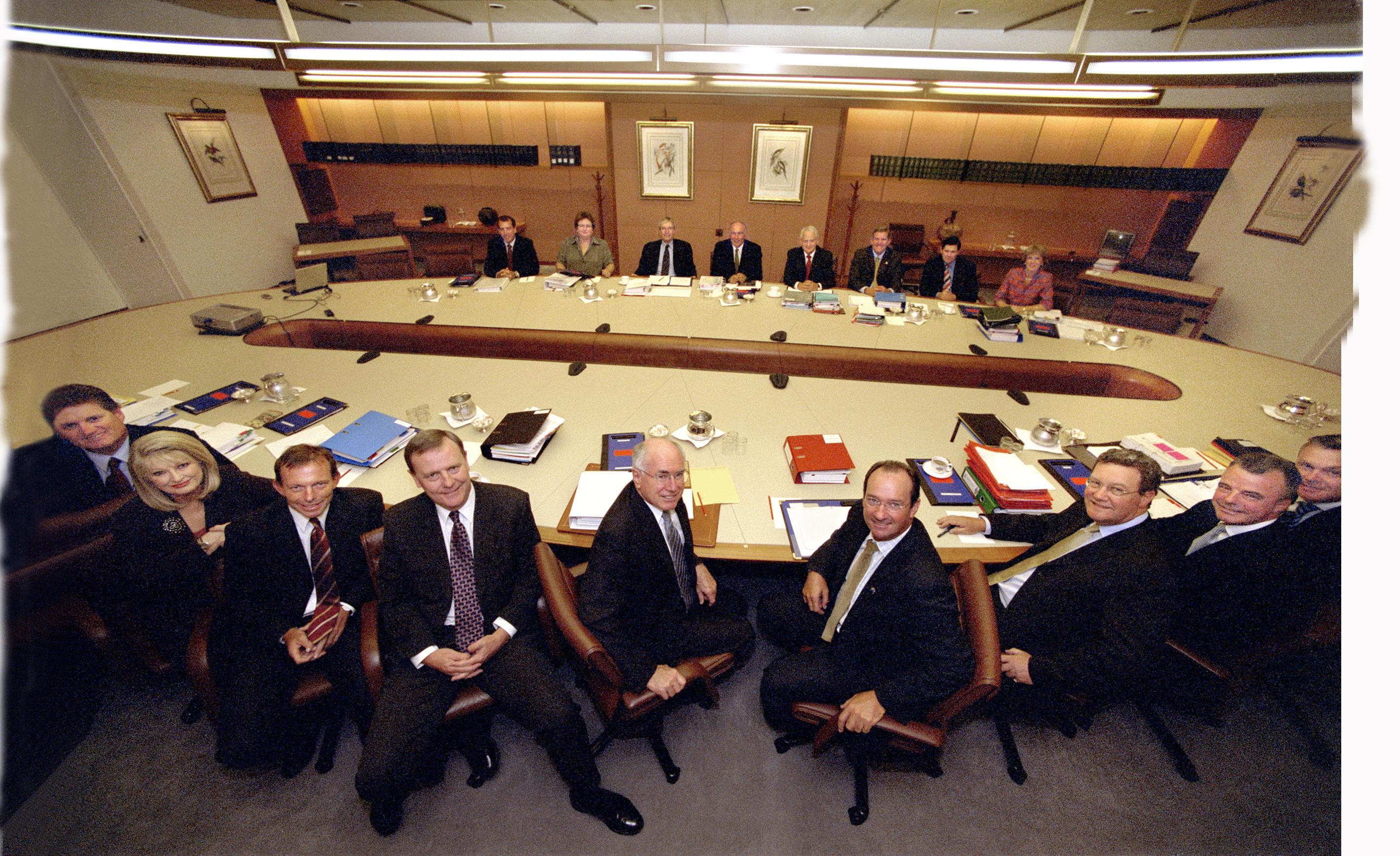
Section 62 of the Constitution suggests that the Federal Executive Council, which is referred to in various provisions of the Constitution, and in the composite expression 'Governor-General in Council', directs the Governor-General as to how to exercise executive power. This is misleading. The real business of government is carried out not in the Federal Executive Council but at meetings of ministers in the Cabinet. Despite the importance of Cabinet as the principal decision-making body in the government, neither it nor the Prime Minister (who presides over Cabinet) is mentioned in the Constitution.
The Commonwealth government generally follows the British practice, initiated in Australia by the later Menzies governments, of having a Cabinet which consists of only the more senior ministers. After the 2022 election there were 23 ministers in Cabinet and 7 'junior' ministers. There were also 12 ministers who were designated 'parliamentary secretaries'.
The practice of having parliamentary secretaries developed in the 1980s to assist Cabinet and junior ministers in the performance of their duties. The Ministers of State Act 1952 provides that, in the case of those designated parliamentary secretaries, the number of ministers is 12 and, in the case of those not so designated, it is 30, resulting in a maximum of 42. Regardless of the designation, each of the 42 is appointed by the Governor-General under section 64 of the Constitution to administer such departments as the Governor-General in Council establishes. Junior ministers and parliamentary secretaries are often asked to attend meetings of Cabinet for the discussion of matters arising in relation to their responsibilities, and occasionally all ministers may be called if some critical issue arises.
The discussion and coordination of government policy which is performed in Cabinet is, in a literal sense, an 'unwritten' feature of the Constitution. A great deal of the activities of departments – especially at higher levels – is directed towards the preparation of written 'Cabinet submissions'. Formally, approval of policy by Cabinet is unnecessary and on matters of detail is not sought. But, in matters of substance, including most matters requiring approval of the Governor-General in Council, it is politically essential. It is through Cabinet that the ministry maintains the harmony of government policy and collective or joint responsibility (see [7.32]) which is one aspect of the theory of ministerial responsibility.
Ministerial responsibility
The term 'ministerial responsibility' is generally used to describe either of 2 kinds of responsibility to which ministers are subject:
- 'collective' responsibility, and
- 'individual' responsibility.
The principle of collective responsibility requires all ministers to accept joint responsibility for, and defend publicly, the policies and actions of the government or else resign. Even if a minister argues strongly in Cabinet that the government should not take certain action, collective responsibility requires the minister to publicly endorse and defend the taking of that action if that is what Cabinet decides.
Individual responsibility is concerned with the responsibility of ministers for their personal actions or the actions of their departments and other bodies they are charged with administering. Traditionally, there have been 3 broad categories of acts and omissions in relation to which a minister has been accused of having failed in his or her responsibilities:
- the minister personally misbehaved
- the minister is personally involved in an error of departmental policy or administration, and
- the minister’s department has, without the minister’s involvement or prior knowledge, acted incompetently or improperly.
With respect to the last category, the contemporary view is that a minister is only responsible for the error if the minister knew or ought to have known about it. Earlier theories of ministerial responsibility which imposed strict liability on a minister for errors made by others ('the minister is responsible for every stamp stuck on an envelope') have long ceased to reflect Australian practice.
As far as the first 2 categories are concerned, it is generally acknowledged that a minister will resign if he or she has done something which shows they are unfit to continue in office. The difficulty is in identifying what type of conduct falls within this category. Except in those cases where a minister’s conduct falls within a recognised category of misconduct, such as committing a serious criminal offence, it is usually not clear whether particular behaviour demonstrates that a person is unfit to be a minister. The decision whether particular behaviour renders a person unfit to be a minister ultimately rests with the Prime Minister, who has the power to either 'request' that the minister resign or advise the Governor-General to dismiss the minister under section 64 of the Constitution, including if any request is refused. In exercising this power the Prime Minister will be influenced by a range of matters including political ethics, parliamentary pressure, party sentiment, community values, media reaction and historical precedent.
Relationship between the executive and the Parliament
The principle of responsible government requires the executive to be 'responsible' to the Parliament. The position is complicated by the fact that in practice the government controls the House of Representatives. It follows that, in many respects, the critical relationship is between the executive and the Senate, which is not ordinarily controlled by government senators. The Senate’s relationship with the government-controlled House of Representatives is discussed in chapter 6.
The general parliamentary process, including questions and debate, provides the major focus of the executive’s accountability to Parliament. The committee system has developed into a primary tool by which members of Parliament can investigate and question ministers and public servants. In addition, the Parliament has regard to the reports of some statutory office holders and authorities which have a level of independence from the executive, such as the Auditor-General, who is designated an independent officer of the Parliament.
Relationship between the executive and the courts
What laws apply to the executive government?
The executive government is required to act lawfully. As we discuss at [9.32]–[9.35] the 'rule of law' is a fundamental concept underpinning the Constitution – it provides that the executive government is subject to, and not above, the law. But, difficult issues can arise in determining which laws apply to the Commonwealth government, and we briefly note these. The Constitution clearly does, as discussed in this book. Much Commonwealth legislation applies to the Commonwealth government, but some expressly or impliedly does not. Some State and Territory legislation seeks to apply to the Commonwealth government, but some expressly or impliedly does not. The Commonwealth sometimes makes itself subject to State and Territory law (see [5.20]). But even where a State or Territory law seeks to apply to the Commonwealth, this can be prevented by Commonwealth legislation working with section 109 of the Constitution (see [4.53]–[4.55]) and the equivalent position for the Territories (see [4.66]). Traditionally the central executive bodies have enjoyed a range of prerogative immunities which limited the laws which applied to them, sometimes described as the 'shield of the Crown', but many of these immunities have now been abolished or are regulated by statute. However, the Commonwealth enjoys some general intergovernmental immunity from State and Territory law, which we discuss at [5.18]–[5.22].
Judicial review
The courts can review whether actions of the Commonwealth executive are legal when they are challenged by persons who have sufficient standing to do so. Section 75(v) of the Constitution provides that the High Court has original jurisdiction in all matters in which 'a writ of Mandamus or prohibition or an injunction is sought against an officer of the Commonwealth'. These writs were the traditional way in which persons affected by actions of the executive government could seek review of these actions by the courts. The Federal Court is given similar jurisdiction by section 39B(1) of the Judiciary Act 1903, and under section 39B(1A) also jurisdiction arising under any laws made by the Parliament, other than criminal matters.
The Commonwealth’s Administrative Decisions (Judicial Review) Act 1977 significantly modernised the way in which persons could seek judicial review of executive decisions. It provides that a person aggrieved by an administrative decision under an enactment can obtain a statement of reasons from the decision-maker and seek review of the decision by the Federal Court and Federal Circuit and Family Court, on specified grounds. These grounds include that:
- there was a breach of the rules of natural justice – that is, a person affected by a decision was not given an appropriate opportunity to be heard or the decision-maker was biased
- there was no evidence or other material to justify the decision, and
- the decision-maker took account of an irrelevant consideration or failed to take account of a relevant consideration.
Review by the courts is essentially of the lawfulness of a decision, not its merits – the courts are concerned with whether the decision was made according to law, not whether it was the correct or preferable decision in the individual circumstances of the case.
Other review
At around the same time as the Commonwealth modernised judicial review, it also provided a system of independent merits review. The Administrative Appeals Tribunal, an independent body, is able to review specific government decisions and to decide itself whether the correct or preferable decision was made. There are other such tribunals. These tribunals exercise executive power; they are not courts exercising judicial power (see [8.9]–[8.10]).
The Ombudsman Act 1976 also provides an important avenue whereby persons can seek redress in relation to executive actions. As does the Australian Human Rights Commission (see [9.60]). The Freedom of Information Act 1982 gives a right of access to official documents, and the Privacy Act 1988 protects personal information held by Commonwealth agencies and some other organisations.
Departments and other agencies
Section 64 of the Constitution allows the Governor-General to appoint ministers to administer 'such departments of State … as the Governor- General in Council may establish'. The Administrative Arrangements Order made by the Governor-General describes each department’s and minister’s responsibilities. More than one person may be appointed to administer one department, and a person may be appointed to administer more than one department. It does not seem permissible for a person to be appointed to administer part only of a department and governments have not purported to make such appointments. The allocation of ministerial responsibilities within a department, where more than one person has been appointed to administer it, is ultimately a matter for the Prime Minister.
In 2022, there were 14 Commonwealth departments:
- Some are central coordinating departments – for example, the Departments of the Prime Minister and Cabinet; Finance; the Treasury; and Foreign Affairs and Trade; and the Attorney-General’s Department.
- Others have a particular policy focus – for example, the Departments of Education; Health and Aged Care; and Agriculture, Fisheries and Forestry.
- Others have a particular policy and service delivery focus – for example, the Departments of Defence (with the Australian Defence Force); Home Affairs (with a range of agencies such as the Australian Border Force and Australian Security Intelligence Organisation); and Social Services (with Services Australia).
In simpler times, the ministers headed a small body of more junior 'Crown servants', most of whom were chosen and subject to dismissal by the monarch personally or by the ministers. In the latter half of the 19th century, however, career public services developed in the Australian colonies and continued to do so in the federation after 1901.
The staff of Commonwealth departments are ordinarily appointed under the Public Service Act 1999. The type of executive action performed by departmental officers ranges from routine clerical tasks to assisting in the formulation and implementation of government policy at the highest level. In accordance with section 64 of the Constitution, and general principles of responsible government, ultimate responsibility for the administration of a department rests with the relevant minister. These principles are reflected in the Public Service Act, which provides that the Australian public service is to be:
- apolitical, performing its functions in an impartial and professional manner, but
- accountable for its actions – within the framework of ministerial responsibility – to the government, the Parliament and the Australian public, and
- responsive to the government in providing frank, honest, comprehensive, accurate and timely advice and in implementing the government’s policies and programs.
Since the 1970s, there has been an increasing use of politically committed staff to advise ministers on matters such as policy formulation. These ministerial advisers are usually employed under the Members of Parliament (Staff) Act 1984. They ordinarily share a similar political outlook to the party in government and are appointed for the period the relevant minister is in office.
Independent statutory bodies and offices
It has always been accepted that the government can engage in conduct through statutory offices and authorities. These are established by particular legislation rather than by the Governor-General under section 64 of the Constitution.
The use of such bodies has its origin in the 19th century, when the colonies had difficulty with political control of government industrial or business activities, notably the government-owned railways, which had been made necessary by the paucity of private developmental capital and enterprise. The colonies experimented with placing these activities under statutory corporate bodies which were free from ministerial control and only required to make regular reports to Parliament. This form solved some problems but caused others when the corporate activities required subsidy, and for much of the 20th century the tendency was to restore some degree of ministerial control.
There are a large number of statutory bodies. The power of ministerial control over these bodies varies greatly. However, even where the legal control by ministers is considerable, it has become usual for the day-to-day activities of these bodies to be left to the management of an individual office holder or board:
- Some of these bodies carry on central government responsibilities but have a level of independence from the government because of the nature of their activities. These include:
- Australian Electoral Commission, which runs the electoral process
- Reserve Bank, and
- Office of the Director of Public Prosecutions.
- Some of these bodies review government activities and have a level of independence for this reason. These include:
- Australian National Audit Office
- Commonwealth Ombudsman
- Inspector-General of Intelligence Services, and
- Administrative Appeals Tribunal.
- Many regulatory agencies are established so as to be independent of political control. These include:
- Australian Competition and Consumer Commission, which regulates trade practices, and
- Civil Aviation Safety Authority, which regulates the safety of civil air operations.
- Many service providers are also independent, including:
- Australian Broadcasting Corporation (ABC) and Special Broadcasting Service (SBS), which provide public broadcasting services, and
- Australian Postal Corporation.
The government also fulfils some functions – particularly service delivery functions – through companies established under the general Corporations Act 2001 and administered under Chapter 3 of the Public Governance, Performance and Accountability Act 2013. Commonwealth bodies which have a significant level of independence (whether as statutory bodies or companies) and carry on commercial operations are called 'government business enterprises'. These are generally run along business lines, often in competition with private sector providers. NBN Co Limited is a company whose shares are owned by the Commonwealth and which operates the Australian broadband network.
Privatisation of government bodies
In the late 1980s and early 1990s, governments began to reassess their involvement in a range of activities – in particular, those undertaken by government business enterprises. Increasingly, governments vacated fields of activity – especially those in which private sector providers were readily available, which were not seen as 'core' governmental activities, and where the government enterprise could be profitably sold in some way.
One example was the Commonwealth Bank, which had existed as a Commonwealth authority in various forms since 1911 (under section 51(xiii) of the Constitution). It provided a range of banking services. From 1990, the statutory entities in the Commonwealth Bank group were converted into a public company limited by shares, with its sole initial shareholder being the Commonwealth. The bank was then no longer a Commonwealth authority. Initially, 30% of Commonwealth Bank shares were sold in a public float. The balance of the shares were subsequently also sold.

