Contents
- Voting at elections for the Parliament
- Qualifications for members
- The principal functions of Parliament
- Legislative powers of the Parliament
- Role of the Senate
- Relations between the houses
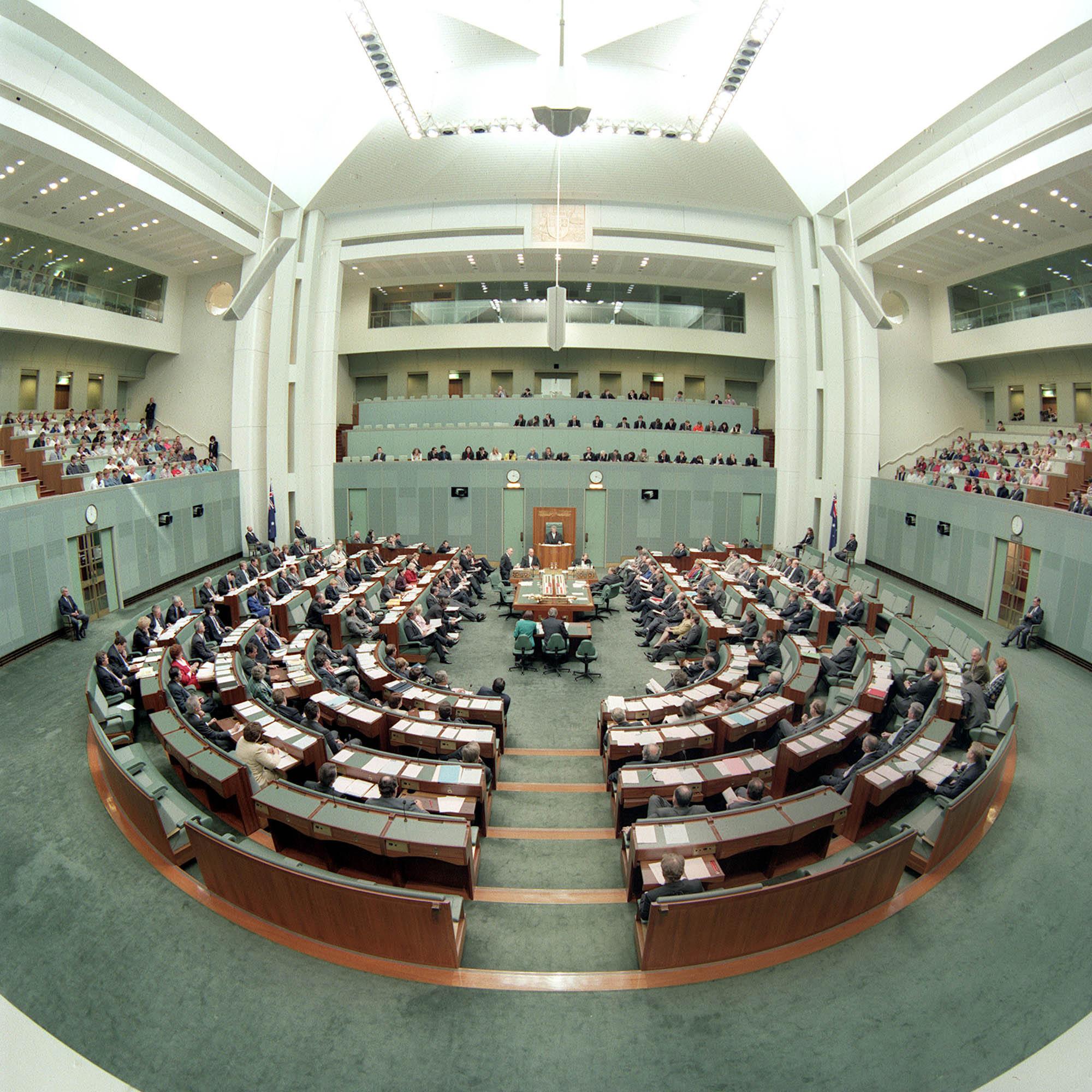

Chapter I of the Constitution deals with the Commonwealth Parliament, to which the Australian people elect representatives who form the government and make laws.
Voting at elections for the Parliament
Right to vote
Section 7 and section 24 of the Constitution provide that the Senate and House of Representatives shall be 'directly chosen by the people'. The Constitution does not set out the qualifications a person must have before they can vote at an election for the Commonwealth Parliament. Instead, the Constitution leaves it largely to the Parliament to prescribe these matters (see section 8 and section 30). Most of the provisions regulating Commonwealth elections are found in the Commonwealth Electoral Act 1918.
Given this, to what extent does the Constitution itself guarantee the right to vote? In McKinlay (1975), a majority of the High Court held that the Constitution did not require the Parliament to prescribe a system of universal adult suffrage. However, it is now clear from the Court’s more recent decisions in McGinty (1996) and Lange (1997) that any franchise which is not based on universal adult suffrage will be unconstitutional.
In Roach (2007) the High Court held invalid amendments to the Commonwealth Electoral Act that had the effect of disqualifying as voters all persons who were serving sentences of imprisonment, whatever the duration, and in Rowe (2010) it held invalid amendments which prevented new enrolments from the date of the writ for the election rather than 7 days after the date of the writ. The Court held that restrictions on the 'right to vote' had to be for a legitimate end and proportionate to achieving that legitimate end. The restrictions in question in these cases were not.
By way of contrast, in Murphy (2016) the Court rejected a challenge to the longstanding stipulation that the electoral roll close at 8 pm 7 days after the date of the writ. It was argued that technological advances meant that the roll could and should stay open until the day of the election so as to maximise the number of eligible electors able to cast a vote. The Court held that the electoral roll was centrally important to the Commonwealth electoral process and that the traditional date for the closing of the rolls served the legitimate purpose of ensuring the orderly and efficient conduct of elections.
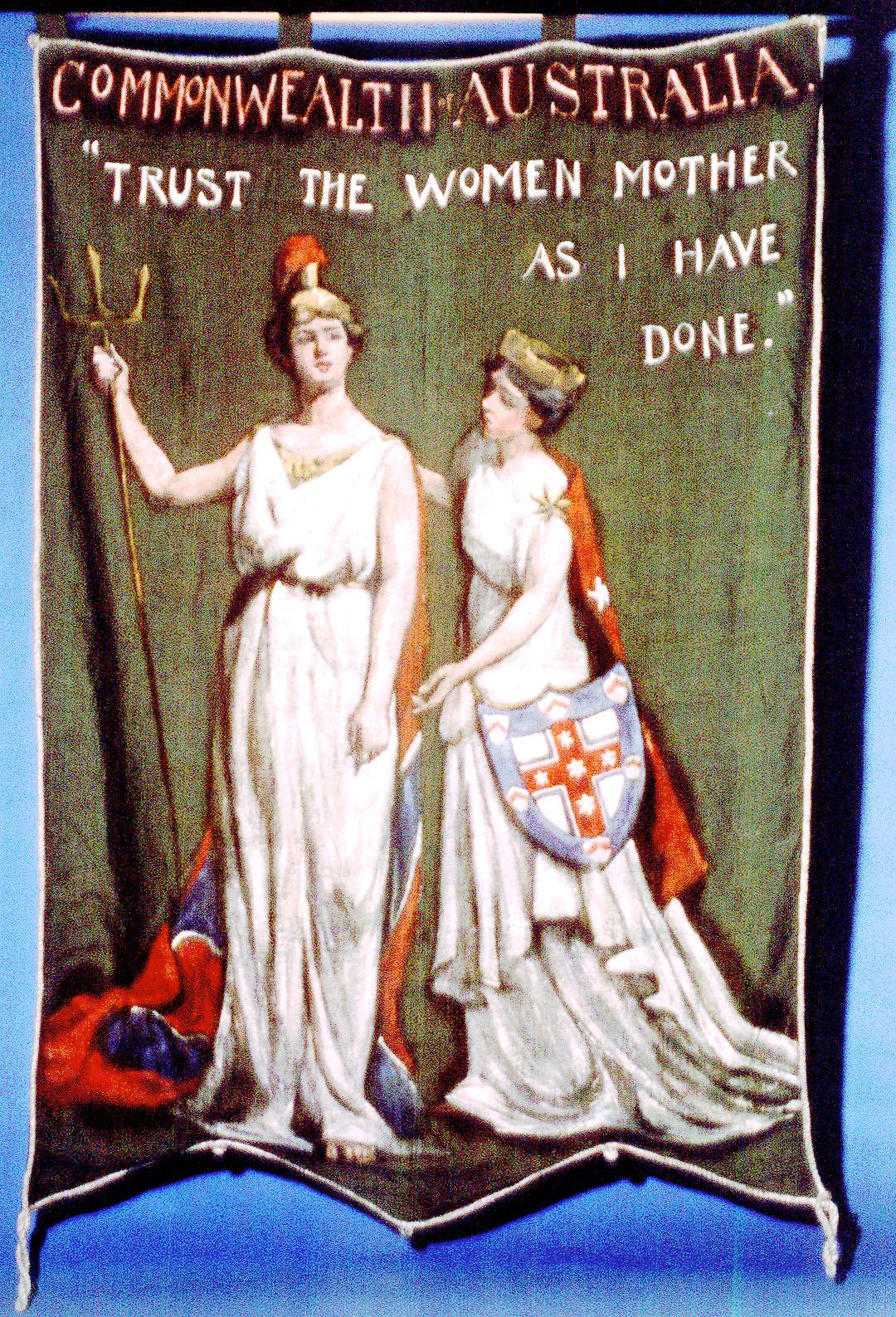
The franchise
The franchise is prescribed by the Commonwealth Parliament in the Commonwealth Electoral Act 1918. For many years the franchise has been based on universal adult suffrage. Generally speaking, all Australian citizens, 18 years and over, are entitled and, indeed, required to vote.
In 1983–1984, the Commonwealth and States agreed to change the basic qualification for voting at elections for Commonwealth and State parliaments from being a British subject to being an Australian citizen. Australian citizenship is acquired primarily by birth in Australia (subject to some exceptions) or 'naturalisation' by the Commonwealth minister responsible for citizenship or one of their delegates (see [3.56]–[3.65]).
The Commonwealth and State statutes which changed the basic qualification for voting provided a cut-off date for the change and preserved the voting rights of persons who were both British subjects and on the electoral rolls at that date. The cut-off date for Commonwealth and State elections was 25 January 1984, except for Queensland, which was 1 August 1983. It is also usual to require a period of residence in Australia and in the relevant electoral division in the voting qualification.
In relation to elections for the Commonwealth Parliament, the Commonwealth Electoral Act makes it compulsory for qualified voters to enrol at an appropriate electoral office and generally attend a voting place, mark a ballot paper and deposit it in a ballot box. There is no requirement to cast a valid vote – that is, it is not an offence to vote informally. Until 1998 it was an offence to encourage persons to fill in a ballot paper informally. In Langer (1996), Albert Langer was unsuccessful in arguing that this provision was unconstitutional, either because of the requirement that members of the House of Representatives be directly chosen by the people (section 24) or because of the implied freedom of political discussion (see [9.38]–[9.45]). The provision of the Commonwealth Electoral Act making it an offence to encourage an informal vote was repealed by the Parliament in 1998.
Voting is secret. Indeed, Australia initiated the regular use of the secret ballot.
Voting systems
No particular system of voting is prescribed by the Constitution. Once again, the Constitution leaves this matter largely to the Parliament to determine. The only significant restrictions which the Constitution places on the Parliament in relation to determining electoral systems for the Parliament are that the method of choosing senators must be uniform for all States (section 9); and an electorate for the House of Representatives cannot be formed out of parts of different States (section 29). Note, however, that there is no constitutional requirement that States must be divided into single-member electorates for the purposes of House of Representatives elections (section 29). Nor is there a constitutional requirement that senators must be chosen from whole States as multi-member constituencies.
The Commonwealth Electoral Act provides for the Senate and the House of Representatives to be elected by different forms of preferential voting. Preferential voting may be contrasted with the system of 'first-past-the-post voting', which was usual in Australia in the 19th century.
Senate
Since 1949 the Australian Senate, elected from whole States as multi-member constituencies, has been chosen by what is known as a single transferable vote system of proportional representation. The peculiarity of this system is that the surplus of votes which a well-supported candidate may have over the quota required for election is distributed among other candidates (with less than full value, depending on the size of the surplus) in accordance with the voters’ preferences.
Otherwise this system shares with the alternative vote, or simple preferential system, the characteristic that if a candidate’s votes do not reach the required quota then that candidate is eliminated and his or her votes are distributed, at full value, in accordance with the voters’ preferences.
Under the Senate ballot paper, prescribed in a schedule to the Commonwealth Electoral Act, electors may vote either 'above the line' or 'below the line'. Registered political parties and candidates that have agreed to be grouped together are identified above the line, and electors can vote for all candidates within that party or group by placing a number in the box adjacent to the party’s or group’s name.
The names of all candidates for the Senate, be they members of a party or a group or independent of a party or group, are listed below the line. Instead of voting above the line, an elector can indicate his or her preference by putting a number next to a preferred candidate below the line.
Prior to the 2016 general election, an elector could vote above the line by simply placing the number 1 adjacent to his or her preferred party or group. The overwhelming majority of electors voted above the line largely because it was much easier than voting below the line. This latter method generally required an elector to mark each box consecutively starting with the number 1 and ending with the number of candidates listed. This could be quite a task given that in some States over a hundred persons were often listed as candidates.
The Parliament came to believe that, despite its simplicity, there were drawbacks in allowing electors to vote above the line by simply marking one box with the number 1. The perceived difficulty was as follows. An elector’s vote would be distributed in accordance with preference cards registered by each party or group with the Australian Electoral Commission. The desire of the major parties to put minor parties or groups ahead of their main political rivals, and the cross-preferencing between minor parties or groups, could result in one or other party or group with tiny primary votes (so-called 'micro parties') ultimately being successful in winning a seat in the Senate once all preferences had been distributed. It also meant that some of an elector’s preferences might go to parties or groups without the elector’s knowledge.
To give electors greater control over the allocation of their preferences, the Commonwealth Electoral Act was amended in 2016 to require electors voting above the line to mark, in the case of a half Senate election, at least 6 boxes consecutively, starting with the number 1 and ending with the number 6. If the party against which the number 1 is allocated has 3 candidates, the elector’s first, second and third preferences will go to those candidates. If the party against which the number 2 is allocated has 2 candidates, the elector’s fourth and fifth preferences will go to those candidates and so on. Under this system, a group or party only attracts an elector’s preference if the elector has consciously selected it.
The 2016 amendments also made it easier for an elector to vote below the line by stating that, in the case of a half-Senate election, the elector could vote by marking at least 12 boxes consecutively, starting with the number 1 and ending with the number 12. Again, a candidate will attract an elector’s preference only if the elector consciously selects them.
House of Representatives
The House of Representatives is elected from single-member constituencies under the preferential voting system. Under this system, a candidate receiving half the first preference votes plus one vote is elected. If no candidate achieves this then the candidate with the fewest votes is eliminated and his or her preferences distributed, at full value, until a candidate obtains the required absolute majority.
The effect of the differences
The difference in the voting systems between the Senate and the House of Representatives has important practical consequences. Specifically, it is much easier for minor parties to gain representation in the Senate than in the House of Representatives. This is because a Senate candidate only requires a little over 14% of the State vote (before or after preferences) to be elected where 6 seats are to be filled in a half Senate election. That is, a candidate needs to attract only one vote more than one-seventh of the votes validly cast to be elected.
If there has been a double dissolution under section 57 of the Constitution, with the result that all 12 Senate seats from a State are to be filled, a Senate candidate requires less than 8% of the State vote to be elected. That is, a candidate needs to attract only one vote more than 1/13th of the votes validly cast to be elected. By way of contrast, a candidate for a House of Representatives seat requires, as just noted, over 50% of the vote in the seat (before or after preferences) to be elected.
Representation in Parliament
Senate
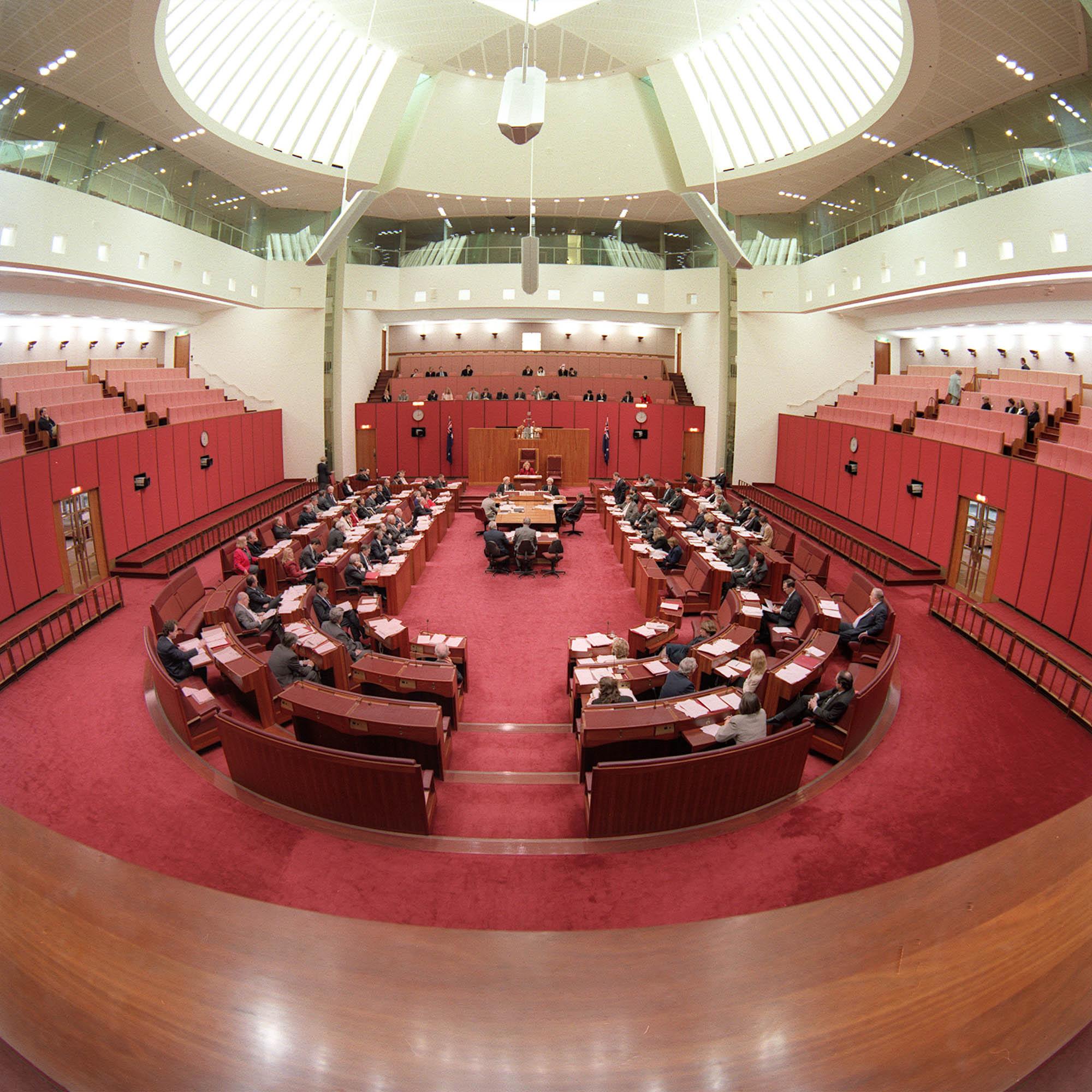
Section 7 of the Constitution guarantees each of the 6 States equal representation in the Senate regardless of the State’s population. Section 7 also allows the Parliament to increase or diminish the number of senators provided equal representation between the 6 States is maintained, and each original State has at least 6.
The number of senators for each State was increased from the original 6 to 10 by the Representation Act 1948 and to the current 12 by the Representation Act 1983. The people of the Northern Territory and the Australian Capital Territory are currently represented by 2 senators each (see sections 40–44 of the Commonwealth Electoral Act). The authority of the Parliament to prescribe the level of parliamentary representation for the Territories is found in section 122 of the Constitution. There are, therefore, 76 senators.
House of Representatives
In the case of the House of Representatives, section 24 of the Constitution limits the number of members to 'as nearly as practicable' twice the number of senators. In determining this 2-to-1 nexus between the House and the Senate, senators and members representing the Territories are ignored (see McKellar (1977)). Section 24 also requires that the number of members chosen from each State is to be 'in proportion to the respective numbers of their people', although each original State must have a minimum of 5 members.
After the 2022 election, there were 151 members of the House of Representatives, elected by about 17.3 million enrolled electors. New South Wales had 47 members, Victoria 39, Queensland 30, Western Australia 15, South Australia 10 and Tasmania the minimum of 5. The Northern Territory was represented by 2 members in the House of Representatives and the Australian Capital Territory by 3.
One vote, one value
In elections for both the Senate and the House of Representatives, a qualified voter shall vote only once (section 8 and section 30 of the Constitution). However, the ideal of 'one vote, one value' also requires a reasonably even distribution of electoral populations.
Senate
This is obviously not possible in relation to Senate elections because of the constitutional requirement that each of the 6 States have equal representation. As a result, at the 2022 federal election the 6 senators from New South Wales were elected by about 5,500,000 enrolled electors (about 910,000 electors per senator) while the 6 senators from Tasmania were elected by just over 400,000 enrolled electors (about 66,000 electors per senator) – a ratio of about 14 to one.
House of Representatives
The position is more complicated in relation to representation in the House of Representatives. While the Constitution, in section 24, requires the distribution of members between States to be proportionate to State populations, the High Court held in McKinlay (1975) that it does not require the distribution of electorates within a State to be equal. This means that, although New South Wales must have more members than any other State because it has more people than any other State, there is currently no recognised constitutional requirement that each electorate within New South Wales must have the same, or approximately the same, number of voters.
In McGinty (1996) the High Court held that the Constitution contained no principle of one vote, one value for elections to State parliaments, nor was there such a principle in the Western Australian Constitution. Although it was not at issue, comments in the judgments indicate that the Court was divided as to whether there is such a general principle for elections to the Commonwealth Parliament.
Even if the High Court were at some future stage to identify an implied requirement of one vote, one value, several of the express constitutional requirements which we have already mentioned prevent each voter within Australia from having precisely the same voting power at elections for the House of Representatives. These include:
- the requirement, in section 29, that electorates for the House of Representatives may not be formed out of parts of different States, and
- the requirement, in section 24, that 5 members at least must be chosen in each of the 6 original States.
Distribution of seats
The practical significance of any constitutional requirement for one vote, one value is currently diminished by the fact that the provisions in the Commonwealth Electoral Act regulating the distribution of seats within a State are based broadly on that principle.
The Commonwealth approach to electoral apportionment is consistent with the Australian trend to empower independent electoral commissions to redistribute at regular intervals on the basis of equality of voters. Modest (generally plus or minus 10%) and rational deviations from this equality are permitted to take account of other legitimate issues such as community of interests within the electorate (including economic, social and regional interests) and the physical features of the electorate.
Under the Commonwealth Electoral Act, the Australian Electoral Commission must undertake a redistribution of a State’s seats if:
- there has been an alteration to the number of members of the House of Representatives to be chosen for the State
- more than one-third of the electoral divisions in the State are malapportioned – that is, different from the average enrolment by 10%, or
- there has not been a redistribution for 7 years.
The electoral redistribution is to endeavour to ensure that, generally 3 years and 6 months after the redistribution, the number of electors enrolled for each division in a State will be within 3.5% of the average electorate enrolment for the State, due consideration being given to community of interests and physical features of the electorate.
Qualifications for members
Section 34 and section 16 of the Constitution (when read with section 51(xxxvi)) together appear to place qualification for membership of the Commonwealth Parliament in the control of the Parliament. The Parliament has used this power to prescribe a number of qualifications in the Commonwealth Electoral Act, including the requirement that a member must be at least 18 years of age. However, a number of provisions of the Constitution itself regulate who may be elected and serve as a member of the Parliament. These provisions, in common with other provisions of the Constitution, can be altered only by referendum, so that these requirements cannot be modified or removed by an exercise of legislative power under section 34.
The Constitution prohibits a person from being a member of both houses (section 43), and the Commonwealth Electoral Act also prohibits a person from being simultaneously a member of the Commonwealth Parliament and of a State parliament or the Legislative Assembly of the Australian Capital Territory or the Northern Territory.
Section 44 of the Constitution sets out various grounds upon which a person is disqualified from becoming or remaining a member of parliament. These include holding an acknowledgment of allegiance, obedience or adherence to, or being a subject or citizen of, a foreign power (section 44(i)); being an undischarged bankrupt or insolvent (section 44(iii)); and holding an office of profit under the Crown (section 44(iv)), including a position in the Commonwealth or State public service.
Electoral disputes
Who determines disputes about the qualifications of members and the conduct of elections? Section 47 of the Constitution would allow the relevant house itself to be the judge of these matters. However, under the Commonwealth Electoral Act the Parliament has placed most questions as to the validity of election results, if disputed, in the hands of the judiciary – specifically, in the Court of Disputed Returns, which is ordinarily the High Court. The Parliament has also made provision for referring qualification and vacancy questions to the Court of Disputed Returns by resolution of the house concerned.
Prior to 2017 there were few High Court decisions on section 44 of the Constitution, other than Sykes v Cleary (1992) and Sue v Hill (1999). However, in recent times there has been an increase in litigation arising out of section 44 that has resulted in a number of parliamentarians being disqualified from becoming or remaining a member of Parliament.
In Re Canavan (2017), the High Court, sitting as the Court of Disputed Returns, considered whether 7 parliamentarians were disqualified from election on the basis of section 44(i) of the Constitution. The High Court concluded that 5 of the 7 parliamentarians were disqualified because they were a subject or citizen of a foreign power. In reaching this conclusion, the Court applied the decision of Sue v Hill (1999), where the Court had held that Heather Hill was incapable of being chosen as a senator because at the time of her nomination she was a citizen of a foreign power (namely, the United Kingdom) within the meaning of section 44(i).
The High Court confirmed in Re Canavan (2017) that the status of being a subject or citizen of a foreign country is to be determined by the law of the foreign country. However, the Court said that section 44(i) would not disqualify a person if the foreign law would 'irremediably' prevent the person from participating in Australia’s representative government. This means that a person will not be disqualified if they can demonstrate that they took all steps reasonably required by the foreign law to renounce their citizenship or if renunciation is simply not possible under the foreign law. The relative difficulty of bringing oneself within this exception was shown in Re Gallagher (2018). The High Court said that it was not sufficient that Katy Gallagher had taken steps to renounce her foreign citizenship by completing a declaration of renunciation and sending the declaration with supporting materials to the United Kingdom Home Office when the declaration had not been processed by the British authorities prior to her nomination as a Senate candidate.
In relation to the disqualification for 'holding an office of profit under the Crown' in section 44(iv), the High Court, sitting as the Court of Disputed Returns, in Sykes v Cleary (1992) held that Phil Cleary, an officer in the teaching service of Victoria who at the time of the election was on leave without pay, held an office of profit under the Crown. He was therefore incapable of being a member of Parliament.
More recently, the High Court reached the same conclusion in respect of Holly Hughes in Re Nash (No 2) (2017), who was a part-time member of a Commonwealth tribunal. In contrast, in Re Lambie (2018), the High Court held that neither the office of mayor nor the office of councillor of Devonport City Council was an 'office of profit under the Crown'. This was because the relevant provisions of the Tasmanian law did not confer power on the executive government over the appointment to, or removal from, either office to the degree necessary for an office of profit to be 'under the Crown' for the purpose of section 44(iv).
Political parties
Members of parliament may be 'independent' or may belong to a political party. Responsible government is, in practice, difficult unless there are reasonably stable groupings of members, a majority of whom are prepared to support the ministry, with the ministers being themselves the leading members of that majority.
Traditionally, nearly all Commonwealth parliamentarians have been members of a political party (however after the 2022 election there were 10 independent members of the House of Representatives). Party affiliation rather than State or regional loyalty generally determines how these parliamentarians vote in Parliament. As a consequence, the assumption made by most of the founders that the Senate would protect the interests of the States by voting along State lines has been largely frustrated.
Despite the immense practical importance of political parties, this critical component of Westminster-style parliamentary democracy gets only the most indirect recognition in the Constitution and is mainly left to conventional practices. Traditionally, political parties were given only minimal recognition by Australian law, at both the Commonwealth and State level. They were private organisations, and the courts were unwilling to treat the agreements or understandings setting them up as capable of legal interpretation or enforcement (see Cameron v Hogan (1934)). The organisation and policies of these parties were found in their rules and resolutions, but they were under no legal requirement to have such documents or inform anyone about them.
However, the private status of parties is changing as a consequence of the developments in electoral law since the 1970s. The Commonwealth, States and Territories now make provision for official registration of political parties and candidates for election, with some information about their constitutions and objectives, and some regulation of party names to avoid confusion by similar naming. At the Commonwealth level 3 developments in particular have led to this:
- First, the filling of casual vacancies in the Senate (see section 15 of the Constitution, amended in 1977) requires identification of the party, if any, to which the departed member belonged and therefore from which the vacancy should be filled.
- Secondly, registered parties and candidates are allowed to have their party affiliation, or independence, printed on the ballot papers.
- Thirdly, since 1983, provision has been made for contributions from public revenue to the election costs of registered parties and candidates.
The registers are open to public inspection and, although it is not compulsory to register, the advantages ensure that all regularly operated parties do so.
There has been increasing regulation of funding of and spending by political parties, and others, with the aim of ensuring fair elections. At the Commonwealth level this regulation is found in the Commonwealth Electoral Act, which requires that candidates, political parties and political campaigners disclose details of donations above a certain level to the Australian Electoral Commission. Since 2018, that legislation has also prohibited foreign donations – broadly, donations from persons and entities that do not have a sufficient connection with Australia – to candidates, political parties and political campaigners for the purpose of funding electoral expenditure. At the State and Territory level this has also included more general donation limits and spending limits, which have given rise to the question whether these offend the implied freedom of political communication. Donation and expenditure caps in relation to elections will generally burden freedom of political communication, in that they will limit what a party or other person can spend on political advertising. So the key question is whether a particular cap has a legitimate purpose, such as preventing corruption in the electoral process. If it does, it will not offend the implied freedom of political communication (see [9.38]–[9.45], especially [9.44]).
The principal functions of Parliament
The Commonwealth Parliament performs 3 main functions:
- It makes laws.
- It provides a ministry to carry on the executive government. The Prime Minister is the leader of the party, or coalition of parties, that has the support of a majority of the House of Representatives (see [6.60]–[6.62]). Other ministers are members of Parliament who are senior members of that party or coalition. The executive prepares the greater part of the legislative and financial proposals for consideration of Parliament.
- It keeps the performance of the government – in particular, that of the ministers and government officials – under continuous scrutiny and discussion.
Privileges and immunities of Parliament
Each house of Parliament has certain special powers which it may exercise itself and confer on its committees. Members also enjoy certain immunities. Section 49 of the Constitution says that the powers, privileges and immunities of each house, parliamentary committee and parliamentarian shall be as declared by the Parliament. Until so declared, these powers, privileges and immunities are to be the same as those which applied to the House of Commons as at 1901. The Parliament has made limited provision in relation to these matters in the Parliamentary Privileges Act 1987. Those matters not dealt with in the Parliamentary Privileges Act are still to be determined by reference to the powers, privileges and immunities of the House of Commons at 1901.
Both houses have power to deal with unruly or contemptuous behaviour by members or visitors in the debating chamber and adjoining offices. In extreme circumstances, bad behaviour is handled by ordering arrest and removal under the supervision of the disciplinary officers, known as the Usher of the Black Rod (Senate) and the Serjeant-at-Arms (House of Representatives). (Note, however, that the Parliamentary Privileges Act removes from a house the power to 'expel' permanently a member from the house.) The Parliamentary Privileges Act also limits the houses’ previously wide contempt powers by abolishing contempt liability for defamatory or critical comments of members and restricting liability to acts or words improperly interfering with the exercise of parliamentary functions.
Several other powers and privileges should be mentioned. First, both houses of Parliament and most parliamentary committees have power to compel persons to attend and give evidence at inquiries by a house or committee – these inquiries illustrate Parliament’s function as the 'grand inquest of the nation'. Secondly, words spoken by members in Parliament and by witnesses before parliamentary committees enjoy absolute immunity and cannot be used, except for very limited purposes, in any court proceedings.
Fitzpatrick and Browne
In 1955 a House of Representatives Committee of Privileges investigated several articles published in the Bankstown Observer which alleged that CAA Morgan, the Member for Reid, was involved in an 'immigration racket'. Raymond Fitzpatrick was the proprietor of the paper and Frank Browne the journalist. The Committee concluded that both Fitzpatrick and Browne were guilty of a serious breach of privilege, and they were called before the bar of the House of Representatives. After hearing them but refusing to hear counsel for Fitzpatrick, the House determined that they be kept in custody for 3 months.
In Fitzpatrick and Browne (1955) the High Court held that the Parliament alone could determine what is contempt and how it should be punished. The Court held that the words of section 49 of the Constitution, and the English constitutional position it incorporated, did not allow for the argument that the courts should determine any breach of privilege or should be able to review any parliamentary determination of contempt. The use of the powers of Parliament in this way has been much criticised. No-one has subsequently been imprisoned by an order of a house. Further, under the Parliamentary Privileges Act, the courts now have the power, should a house commit a person to prison for contempt, to determine whether the acts which a person is alleged to have done are capable of improperly interfering with the exercise of parliamentary functions.
Business of the houses
Each house of Parliament has general control over its procedure and internal discipline. These are regulated by standing orders, which continue from parliament to parliament, by session orders expiring at the end of a session and by more temporary and ad hoc orders. The general purpose of these orders is to ensure that the government is able to manage the business of the Parliament without undue obstruction but that the opposition, other parties and independent members have a reasonable opportunity to criticise and put their point of view. The rules of debate are designed to define issues under discussion and ensure that a definite conclusion is reached in accordance with the nature of the business.
The supervision of the proceedings is in the hands of the Speaker of the House of Representatives and the President of the Senate. Although elected by majorities in the houses, these officers are expected (in principle) to maintain a reasonable degree of impartiality. They have the assistance of clerks and ushers concerned with administration, documents and the preservation of order.
An aspect of responsible government is the convention that the government is entitled to general control of the order of business of the House of Representatives and is also entitled to a reasonable opportunity to get its business through the Senate, even when it lacks majority support there. The following types of parliamentary business are dealt with in a normal sitting day:
- tabling of reports and papers
- questions from members, usually (though not necessarily) addressed to ministers. They may be written or oral, and there is no legal obligation to answer, but convention and political advantage usually ensure that they are answered. Some exceptions exist, with the most important being the convention that ministers do not answer questions about future government policy
- motions to discuss urgent matters of public importance
- petitions from electors (view an unusual petition)
- statements by ministers, usually to announce or explain policy
- grievance and adjournment debates, when short statements may be made on current matters, and
- consideration of Bills for proposed laws.
Passage of a Bill
Nearly every Bill 'for an Act' presented to the Commonwealth Parliament is proposed by the government. They represent the implementation of government policy in proposed laws, generally approved by the Cabinet. Legislation can be introduced either in the House of Representatives or in the Senate (except proposed laws appropriating revenue or moneys, or imposing taxation – see section 53 of the Constitution and [6.84]–[6.85]), but most commence in the House. The usual stages for a Bill which commences in the House of Representatives are as follows:
- The first reading of a Bill is a formal stage. There is no debate.
- The second reading speech usually follows immediately and is made by the responsible minister. This outlines the basic policy, purpose and features of the Bill. The explanatory memorandum for the Bill is presented. The Acts Interpretation Act 1901 allows the second reading speech and the explanatory memorandum to be used in interpreting a law. The Bill is sometimes then referred to a committee for an advisory report or to the Federation Chamber – a committee established as an alternative to the main chamber of the House of Representatives.
- The principles of the Bill are then debated and the second reading motion determined.
- Consideration in detail (formerly, and still in the Senate, called the committee stage) provides an opportunity to debate each clause of the Bill. Amendments are able to be moved at this stage, though usually only government amendments are passed.
- There is then a third reading. Debate at this stage is possible but rare.
- The Bill is then referred to the Senate. The procedures the Senate follows are in similar form.
- Because the balance of power in the Senate is usually held by minority parties, non-government amendments are often proposed and passed there. However, section 53 of the Constitution provides that the Senate may not amend proposed laws imposing taxation or appropriating revenue or moneys for the ordinary annual services of the government or so as to increase any proposed charge or burden on the people. However, the Senate can 'request' the House to make such amendments (see [6.84]–[6.85]).
- A Bill which has been passed in identical form by both houses is presented to the Governor-General for the King’s assent (section 58 of the Constitution).
- The Act commences – that is, comes into effect – generally either on assent or at some later time.
Government
As noted, the Prime Minister is the leader of the party (or coalition of parties) that has the support of a majority of the House of Representatives. Other ministers are members of Parliament who are generally senior members of that party or coalition. These ministers together make up the core of the executive government, which we discuss in greater detail in chapter 7, especially at [7.27]–[7.30]. It is not necessary for the government to have the support of the majority of the Senate; indeed, this has been rare in recent times.
Further, it is not necessary for that party or coalition of parties to have a majority of seats in the House of Representatives. A parliament without a majority party or coalition is sometimes called a 'hung parliament' and the government a 'minority government'. It was not until the election of the Fisher Labor government in 1910 that one party or coalition had a majority of seats in the House of Representatives; until then there were 3 major parties in the Parliament, none of which had a majority of seats. More recently, from 2010, the Gillard and second Rudd Labor governments did not have a majority of seats but relied on the support of independents and minor parties to form government. This situation also arose in 2018, when the coalition government lost its majority in the House of Representatives mid-term through a sequence of events, including a defeat in a by-election.
The basic principle is that the Governor-General must appoint as Prime Minister the person best able to form a government, enjoying the confidence of the House. The Governor-General should decline to exercise any independent discretion in the choice of Prime Minister unless it is absolutely unavoidable.
Opposition
The opposition is the party (or coalition of parties) that has the largest number of non-government members in the House of Representatives. The opposition generally checks and criticises the government’s policies, decisions and legislation, and it provides an 'alternative government' for the Parliament and the electorate. The concept of an opposition is not recognised in the Constitution, but an effective opposition is generally considered an essential element of parliamentary democracy. The leader of the opposition has a significant parliamentary and public role, and the shadow ministry is the alternative executive government.
Despite the fact that nearly all legislation is proposed on the initiative of ministers, it is open to the opposition or an individual member to propose legislation, and some time is regularly set aside for non-government business. However, the ability of the opposition or individual members to assert themselves in the legislative process is small.
Legislative powers of the Parliament
The Commonwealth Parliament does not have law-making power over all subject matters. Its legislative powers are confined to those matters set out in the Constitution, principally in section 51. Those powers are also subject to any express or implied limitations in the Constitution. Despite the limited legislative power of the Commonwealth, it has nevertheless assumed a predominant law-making position over the States in the federation (see chapter 5). Many of the most important decisions of the High Court have dealt with the scope of the powers of the Commonwealth Parliament. We note here some of the key powers and legislation which is supported by them.
Interstate and overseas trade
The desire to have a single trade area throughout Australia was one of the key reasons for federation. In addition to providing this, the Constitution gives the Commonwealth Parliament power to make laws concerning trade and commerce with other countries and among the States (section 51(i)). The Commonwealth does not have power to deal with trade within a State, even if, as is often now the case, this is intermingled with interstate and overseas trade. At the time of federation a major political division was between free traders and protectionists and, importantly, the international trade power and section 90 left this issue to be determined by the Commonwealth Parliament. The Commonwealth’s power in relation to trade among the States is subject to section 92, which supports a single trade area in Australia by providing that trade and commerce among the States shall be absolutely free (see further at [9.17]–[9.19]). Commonwealth legislation providing for competitive markets and consumer protection in trade – in particular, the Competition and Consumer Act 2010 – and the regulation of air, sea and land transport is supported in part by this power.
Taxation
The Commonwealth has power to make laws with respect to taxation (section 51(ii)). A tax is generally a compulsory exaction of money by the government for public purposes, but it does not involve a payment for services such as power or communications. The Commonwealth raises most of its revenue through income tax, customs and excise duties and the goods and services tax (see [5.70] and generally [5.37]–[5.75]). However, this power cannot be used to 'discriminate between States and parts of States'. This prohibition is particularly relevant to whether the Commonwealth can have differential taxation regimes in Australia – for example, to benefit people or encourage activities in regional or remote areas.
Defence
Another key reason for federation was defence concerns. The Commonwealth has power therefore in relation to defence (section 51(vi)), which extends to both external and internal threats. In times of war, this power expands to enable the Commonwealth to regulate a very wide range of activities and exercise a wide range of powers not available in times of peace (see [5.14]).
Migration
The Commonwealth has power in relation to naturalisation and aliens, generally people who are not citizens (section 51(xix)) and immigration and emigration (section 51(xxvii)). These powers enable the Commonwealth to regulate migration to Australia – another issue which was particularly important at federation – and implementation of the white Australia policy was one of the first laws passed by the Commonwealth Parliament. That policy has been abandoned. Australia has seen very significant immigration since World War II, and management of this occurs through the Migration Act 1958.
Corporations
Section 51(xx) provides for the Commonwealth to have power in relation to a broad range of corporations. Given that most business is now undertaken by corporations, this power supports much of the Commonwealth’s commercial regulation, including the Competition and Consumer Act and the Fair Work Act 2009. The Corporations Act 2001 itself is supported by significant referrals of power from the States (see [5.89]–[5.90]) rather than the corporations' power, in part because in 1990 the High Court held that the corporations' power did not extend to the actual formation of companies, as distinct from their operation (see [5.14]–[5.15]).
Social services
The Commonwealth has significant power in relation to social services. This power was originally expressed as concerning invalid and old-age pensions (section 51(xxiii)). The movement towards federation occurred at a time when the political labour movement and the welfare state were developing, and these were early social services being considered at that time. In 1946 a successful referendum added a range of other social service benefits in section 51(xxiiiA), including maternity allowances, child endowment, unemployment benefits, sickness benefits, medical and dental services, and benefits to students and family allowances.
People of any race
Section 51(xxvi) gives the Commonwealth power in relation to people of any race for whom it is deemed necessary to make special laws. This was included to enable discriminatory laws in relation to non-Europeans. As discussed at [10.11]–[10.12], in 1967 the exception from the original power of 'the aboriginal race' was removed. This enabled the Commonwealth to make laws for Indigenous people. The use of this power is now focused on Aboriginal and Torres Strait Islanders, including in relation to heritage and native title (see [10.27]–[10.30]).
External affairs
The Commonwealth has power in relation to external affairs (section 51(xxix)). As discussed at [5.23]–[5.33], the High Court’s decisions that this extended to allowing the Commonwealth to implement treaty obligations has been an important development in the 20th century which expanded the reach of Commonwealth power. Laws implementing international human rights obligations, such as the Racial Discrimination Act 1975, and international environmental obligations, such as the Environment Protection and Biodiversity Conservation Act 1999, are primarily made under this power.
Industrial disputes
Section 51(xxxv) provides power on 'conciliation and arbitration for the prevention and settlement of industrial disputes extending beyond the limits of any one State'. The move towards federation occurred at a time of the development of the labour movement and significant industrial disputes. This power was included to enable the Commonwealth to make laws to prevent and resolve such disputes but only of the limited class of those extending beyond a State. Disputes within a State were left to the State systems to resolve. This power was the subject of much litigation as to its reach. Its importance as a head of power diminished significantly in 2006, when the High Court upheld the move by the Commonwealth Parliament to support the Commonwealth industrial relations legislation, the Fair Work Act, with the broader corporations power (section 51(xx)), which is not limited to disputes extending beyond a State (see [5.14]).
Referrals and requests
Under section 51(xxxvii) the States can refer to the Commonwealth Parliament the power to make laws for the State on matters otherwise outside the areas specified by the Constitution. Alternatively, a State can adopt such a law already made by the Commonwealth. As we note at [5.90]–[5.91] significant legislation, such as the Corporations Act, is now based on such referrals of power from the States.
Section 51(xxxviii) enables the Commonwealth at the request of the relevant States to make laws which, at the establishment of the Constitution, could have been made only by 'the Parliament of the United Kingdom or the Federal Council of Australasia'. To some extent this is a 'backstop' to ensure that Australian parliaments can together deal with all relevant matters. As discussed at [3.28]–[3.29] and [5.92]–[5.93], the Australia Act 1986 was passed by the Commonwealth Parliament at the request and with the consent of each State parliament under section 51(xxxviii), as were the recent changes in the rules of royal succession for the Australian monarch (see [3.35]).
Nationhood
Apart from those listed in section 51, the legislative powers of the Commonwealth Parliament include what is often referred to as the 'nationhood power'. The precise basis and scope of this power is not entirely clear, but the High Court has consistently accepted that the Commonwealth Parliament may legislate on certain matters because the Commonwealth represents the nation as a whole. Examples include prescribing the national flag and anthem and establishing institutions such as the National Gallery of Australia.
More generally, the Court has accepted that the Commonwealth may engage in 'enterprises and activities peculiarly adapted to the government of a nation and which cannot otherwise be carried on for the benefit of the nation'. It was this power which a majority of the High Court found, in Pape (2009), supported the Commonwealth’s payments to over 7 million Australians in response to the 2008–2009 Global Financial Crisis. The Court held that a payment of this scale was an activity peculiarly adapted to the central government and one which the Commonwealth alone could implement given its financial strength relative to that of the States.
Other legislative powers
The Commonwealth Parliament also has 'incidental powers'. Section 51(xxxix) specifically provides that the Parliament has power to make laws on matters incidental to the execution of any power vested by the Constitution in the Parliament, either house of Parliament, the government, the federal judicature or any department or officer of the Commonwealth. For example, the Public Service Act 1999, which regulates the engagement of persons to the Australian Public Service, can be supported under section 51(xxxix) because it is incidental to the performance of functions by the executive government.
Section 51(xxxvi) gives to Parliament legislative power over 'matters in respect of which this Constitution makes provision until Parliament otherwise provides'. Provisions dealing with many machinery matters are scattered through the Constitution in terms that include 'until the Parliament otherwise provides'. The use of this proviso means that these matters may, and generally are, regulated by legislation under section 51(xxxvi). Also, the trade and commerce power in section 51(i) is further defined in section 98. Section 122 gives the Parliament a general power to make laws for federal territories (see [4.60]–[4.77]).
Section 52 gives the Commonwealth Parliament exclusive power to make laws in relation to some matters. In particular, this includes the seat of government, now Canberra in the Australian Capital Territory (see section 125 and the Seat of Government Acceptance Act 1909) and all places acquired by the Commonwealth.
Role of the Senate
In the case of bicameral (2 house) parliaments like the Commonwealth Parliament, it is commonly said that the government and its ministers are 'responsible' only to the lower house – the House of Representatives. This is true in the sense that a government only needs the support of a majority of members in that House and need not have the support of a majority in the Senate. However, it is also true that the powers of the Senate are sufficient to enable it to negotiate with the government and in the last resort make it impossible for it to carry on government – a situation which may lead to an election.
So long as upper houses were composed of nominees, or elected on a special franchise, there was a tendency to treat them in principle as 'revising' houses, similar to the British House of Lords. Under this view the Senate should accept restrictions on its power to initiate and amend money Bills and to amend other Bills, similar to those restrictions which the House of Lords had adopted by convention. (Even in the British case, the convention was eventually found insufficient, and the Parliament Acts of 1911 and 1949 restricted the power of the Lords more stringently by statute.) But, in Australia, constitutional restrictions on the power of the State upper houses, adopted in the 19th century, were less stringent and were models for the provisions applied to the Senate by sections 53, 54 and 55 of the Constitution. Further, from its inception, the Senate was a wholly elected body, although on a basis which represented the States equally.
Under section 53, the Senate has equal power with the House of Representatives with respect to all proposed laws apart from those appropriating revenue, imposing taxation or proposing a charge or burden on the people. Specifically, section 53 requires tax and spending Bills to originate in the House of Representatives, and prevents the Senate from amending tax Bills and Bills appropriating revenue for ordinary annual services, and from increasing any proposed charge or burden.
But the Senate can reject any tax or spending Bill, and where it cannot amend it can suggest amendments. In practice, the Senate has at times persisted with 'suggestions' in a way almost equivalent to amendment, though by doing so it creates the risk of causing a double dissolution under section 57 since persistent 'suggestion' could be treated as 'failure to pass' the Bill (see [6.91]–[6.93]).
The government often does not have a majority in the Senate. Indeed, government senators have been outnumbered since July 1962, except for the period from 1976 to 1981 and 2004 to 2007. One reason for this has already been noted – the fact that the electoral system for the Senate provides a better opportunity for small parties to gain representation there (see [6.22]–[6.23]).
Relations between the houses
It follows that disputes may, and often do, arise between the 2 houses as to whether a Bill should be passed in its proposed form. The Senate has never accepted the view that it is solely a revising chamber. Hence, the tendency is for the Senate to treat the specific legal restrictions on its powers in the Constitution as the only restrictions, and what it does otherwise as a matter for political judgment.
The fact that section 57 provides a means by which inter-house deadlocks can be settled by an appeal to the people is sometimes cited as an additional reason why the Senate should not necessarily defer to the views of the government. Indeed, as a general comment, the more specific legal provisions there are to deal with constitutional questions, such as inter-house relations, the less likely is it that clear conventions will be developed or observed.
Nevertheless, the actual behaviour of the Senate, when in conflict with the House of Representatives, has been at least partly along the lines of a 'revising chamber' of conventional theory. There are 2 main principles underlying this approach:
- The first principle is that the Senate should not use its power to reject vital measures (such as taxation Bills and appropriation Bills making up the ordinary annual budget) to bring down or force an election on a ministry that has the support of the House of Representatives.
- The second principle is that the Senate should not reject or materially amend legislation of any kind brought forward by the ministry if the relevant party or coalition specifically promised that legislation at a general election that brought it to power – the principle of the electoral mandate.
With respect to the first principle, in the 20th century there have been 2 outstanding cases of an upper house refusing supply in order to force an election – Victoria in 1947 and the Senate itself in 1975 (see [7.19]–[7.26]). In the latter case, which led to the dismissal of the Whitlam Labor government, the political leader responsible for the blocking of supply, Malcom Fraser, said that this action should be taken only in 'extraordinary or reprehensible circumstances'. As the events in 1975 showed, the application of this test is entirely a matter of political opinion. On the 'electoral mandate' point the record is even less clear, with the Senate from time to time rejecting or amending legislation contrary to this principle.
Section 57
Section 57 of the Constitution provides the following procedure to solve inter-house deadlocks in relation to a proposed law:
- The House of Representatives passes any proposed law and the Senate rejects or fails to pass it or passes it with amendments to which the House will not agree.
- After an interval of 3 months, the House again passes the proposed law and the Senate again rejects or fails to pass it or passes it with amendments to which the House will not agree.
- The Governor-General, on the advice of the Prime Minister, may dissolve the Senate and the House simultaneously.
- The new House again passes the proposed law and the new Senate again rejects or fails to pass it or passes it with amendments to which the House will not agree.
- The Governor-General may, on advice, convene a joint sitting of the members of the Senate and the House.
- The proposed law is made if it is affirmed by an absolute majority of the total number of the members of the Senate and House of Representatives at that sitting.
The double dissolution of Parliament has occurred on 7 occasions: 1914, 1951, 1974, 1975, 1983, 1987 and 2016. On only one occasion has the process been concluded and laws passed at a joint sitting, and that was in 1974. In the Petroleum and Minerals Authority Bill case (1975), the High Court held that the requirements of section 57 had not been met in relation to that Bill. In the First Territorial Senators case (1975), the High Court held that the requirements of section 57 had been met in relation to the 3 Bills under consideration in that case.
A practical problem which section 57 creates is that of deciding what constitutes a failure by the Senate to pass a Bill, where there is no outright rejection but some sort of delaying tactic, as occurred in 1951. It is a matter for common sense judgment by the Governor-General, guided by advice from the Prime Minister and the Attorney-General. Of course, as the cases referred to in [6.92] show, it would ultimately be a matter for the High Court to determine if the validity of any legislation passed in a joint sitting were challenged on the ground that the constitutional preconditions for the double dissolution had not been satisfied.
In 1914, the Governor-General, with the assent of the Prime Minister, sought and obtained advice on a double dissolution problem from the Chief Justice of the High Court. In 1975, similar advice was obtained without the consent of the Prime Minister, not directly on the double dissolution issue but on the question whether refusal of supply had created the circumstances which would justify dismissal of the Prime Minister and the appointment of a new Prime Minister, on the understanding that the new Prime Minister would request a double dissolution. This resort to the judiciary had precedents in earlier State history but was viewed by some commentators as unwise in the Commonwealth setting because of the crucial role of the High Court as constitutional interpreter. It is unlikely future justices of the High Court will give such advice.